

The situation surrounding the war in Ukraine remains extremely tense. US and EU attempts to end the war in Ukraine are failing to yield clear and effective results. Another round of talks is currently underway in Abu Dhabi, but fighting continues, and lives continue to be lost. It is now clear that this war will not change the past; the inhumane shelling will lead to the city’s slow decline.
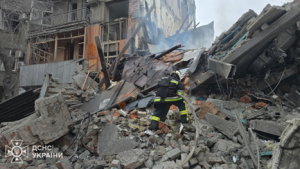
One of Moscow’s key demands in the draft peace agreement, which remains unclear and closed to the public, concerns Ukrainian territory. Russian President Vladimir Putin continues to insist that Ukraine must completely renounce its territories – Donbas and Crimea. Meanwhile, Ukrainian President Volodymyr Zelenskyy and his European counterparts insist on freezing the conflict along the line of contact and taking new tangible steps toward ending the war. Consequently, bloody, attritional fighting continues in the Donetsk region, which is almost entirely occupied by Moscow. Both sides are suffering casualties, civilians are dying, and the war remains at a stalemate.
The Donbas region has been outside Ukraine’s sphere of influence for 12 years now, and its fate could follow that of Kharkiv, Ukraine’s second-largest city and a major scientific, technical, and transportation hub. Many ongoing developments suggest that Russia has prepared a most unenviable fate for this million-plus city: Kharkiv could soon be turned into an abandoned ghost town, like the deserted Kherson, whose population was forced to flee the war. Pro-government Russian bloggers and media outlets affiliated with the security forces are now openly voicing this view. You can see one such cynical comment below. It is not possible to verify the authenticity of the comment because the author deleted their tweet.
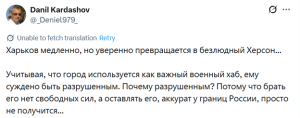
Translation of the publication @_Deniel979_: «Kharkiv is slowly but surely turning into a deserted Kherson… Considering that the city is used as an important military hub, it is destined to be destroyed. Why destroyed? Because taking it with available forces and leaving it, right on Russia’s borders, is simply not an option…».
At the end of 2025, Putin tasked his General Staff with creating a buffer zone on the Ukrainian-Russian border. This would allow Russian troops the necessary room to manoeuvre and time to pause and catch their breath. For Ukraine, this would mean a fatal advance of Russian troops in the southeastern and eastern parts of the country.
An interactive map, presumably prepared for a Russian Ministry of Defence meeting, shows Kyiv’s danger zone extending 40 kilometres from the state border that once separated the two neighbouring countries. It shows that the republics created by Russia, the «Donetsk People’s Republic» and the «Luhansk People’s Republic», are already fully incorporated into Russia, while in the Zaporizhia and Kherson oblasts, the border and demilitarised buffer zone run along the current front line. Despite the fact that the regional cities of Kherson and Zaporizhia, which are the administrative capitals of their regions, are part of Ukraine, the Russian Ministry of Defence has claimed them as its own.
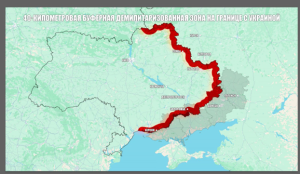
This diagram clearly shows that, due to its proximity to the Russian border, most of Kharkiv falls within the buffer zone. Unlike other Ukrainian cities, Kharkiv and Sumy fall within this zone not because they are close to Russia’s “new borders,” but because they are adjacent to the so-called “old territories.” Putin’s desire to create a buffer zone is primarily driven by the Ukrainian breakthrough into the Kursk region in the summer of 2024, which resulted in a complete failure for the Russian Armed Forces, although the Russian army subsequently recaptured the territory. This operation by the Ukrainian Armed Forces became the most embarrassing moment for Moscow during the current armed conflict.
Despite the frontline shifting from village to village, shifting hands between the Russian Armed Forces and the Ukrainian army, Moscow simply lacks the strength to capture Kharkiv.
Russian troops failed to capture the city in 2014, when Donetsk and Luhansk, with Russian support, declared their independence. That year is widely considered the beginning of a proxy war in which Russia may have participated, although there is no clear evidence of this in the media. That year, the “Russian Spring” protests erupted across almost all of Ukraine, predominantly Russian-speaking Ukraine.
Protests involving Russian loyalists from among the Ukrainian population took place in 2014, including in Kharkiv. It all began with the large-scale demonstrations of Ukrainians at the Euromaidan in Kyiv in 2013 over then-President Viktor Yanukovych‘s refusal to sign an association agreement with the European Union. Russia suffered another setback in 2022 during its full-scale invasion of Ukraine.
Many military experts from Europe and NATO suggest that Russia lacks the resources to capture a city of over 1 million residents, comparable to Munich in Germany, Milan in Italy, or Birmingham in the UK.
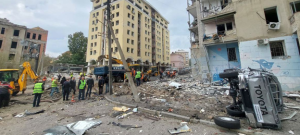
According to sources close to Ukraine’s Main Intelligence Directorate, Moscow has developed a plan to gradually destroy Kharkiv’s entire public utility, transportation, and energy infrastructure, with the goal of rendering the city uninhabitable. This strategy is being used to destroy the city from within and force its residents to abandon it. This will create a buffer and demilitarised zone to create operational space for the Russian army.
Many believe this information is accurate, despite the fact that it closely resembles propaganda issued directly from the Kremlin walls.
Following Putin’s December statements about the need to create a demilitarised buffer zone along the Russian border, the intensity of attacks on the city has increased significantly. Residents are already suffering sleepless nights, seeing neighbours and friends killed by missiles, and living in cold apartments and houses without power, water, or heat due to the destruction of public utilities during an unusually cold winter in Ukraine.
In late 2025, a missile strike significantly damaged the Pechenigye Reservoir dam, and thermal power facilities were hit. In early 2026, the intensity of Russian fire increased even further, with Iskander ballistic missiles hitting the city centre, despite Russia previously refraining from such attacks due to their lethality and the potential for civilian casualties. Several power plants in one building were knocked out a few days later. Moreover, Russia resorted to striking the city centre during daylight hours. And these are only the facts that have been publicly disclosed.
At a recent meeting with NATO Secretary General Mark Rutte, Ukrainian President Volodymyr Zelenskyy, while discussing the energy supply difficulties in Ukraine, specifically focused on Kharkiv, where hundreds of thousands of people live without power and heat. To address the situation, he requested additional air defence systems from Western partners to protect the city. However, military analysts believe that there is no point in hoping for comprehensive support from EU and NATO countries for Ukraine, or that this will be able to cover the city with a «sky dome completely».
Kharkiv residents already live under constant rolling blackouts, attacks from cruise and ballistic missiles, drones, and glide bombs. Pre-war Kharkiv had a population of over 1.5 million, a third of whom had already fled their homes. Today, approximately 1.2 million people live here, 200,000 of whom are displaced from cities in the Kharkiv region, which Russian troops are also advancing on.
The Kremlin’s plans revolve around the successful seizure of Kharkiv Oblast territory and the transformation of Kharkiv itself from a scientific and industrial centre into a deserted ghost town. This could lead to something neither Brussels nor Kyiv wants, nor did Washington under Democratic President Joe Biden—conditions under which Zelenskyy will be forced to make peace on Moscow’s terms: the loss of territory, Ukraine’s non-aligned status, troop restrictions, and much more. This means that the coming year could become a true apocalypse and a struggle for survival for Kharkiv residents.
