
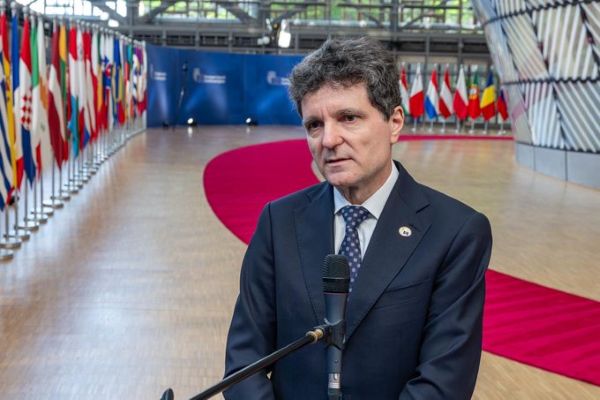
Romanian lawmakers voted against a new government proposed by Prime Minister-designate Adrian Vestea late Monday, an effort to resolve the ongoing political crisis in the country. The vote was 189 in favour, 23 against, with a significant number of lawmakers abstaining. The proposal required at least 233 votes to pass, underscoring the challenges faced in establishing stable governance in Romania.
This decision concludes several months of political instability that began with a no-confidence vote in May that ousted the previous government. Romanian President Nicușor Dan appointed Vestea, a long-time member of the National Liberal Party (PNL), under the premise that his extensive administrative experience would facilitate the formation of a new government. Vestea was the second candidate nominated by President Dan, following the unsuccessful attempt by Eugen Tomac, who did not present a cabinet within the mandated timeframe.
The failed confidence vote for Vestea’s proposed cabinet is expected to intensify the existing turmoil, particularly as Romania currently grapples with one of the largest budget deficits in the European Union. In his address to lawmakers, Vestea described the current period as “complex,” emphasising a growing distrust between citizens and the state, alongside serious economic challenges and accumulated social tensions. He asserted that the underlying issue facing Romania is fundamentally a crisis of trust.
Vestea submitted his governing programme and ministerial nominations to Parliament on Sunday. However, President Dan did not consult with the PNL before his nomination. While Vestea’s proposed cabinet received backing from the largest parliamentary party, the Social Democratic Party (PSD), he did not secure support from his own party.
On Monday, Vestea also met with George Simion, the leader of the extremist opposition party, the Alliance for the Unity of Romanians (AUR). Following their meeting, Simion declared that AUR would not support Vestea’s cabinet, and AUR lawmakers walked out of Parliament before casting their votes.
Sorin Grindeanu, leader of the PSD, told journalists before the final vote that his party was unlikely to support a minority government, while commending Vestea for his willingness to take on the challenge. He remarked, “There are others who were not even present at the vote… acting as moralists, but it is not my role to judge them.”
Political consultant Cristian Andrei commented that the vote’s outcome appears to favour AUR, demonstrating the inability of mainstream parties to govern effectively. He forecasted that the political crisis is likely to persist. He noted, “There is a challenging road ahead in securing a majority, as the pro-Western parties remain in perpetual conflict. Instability and populism seem to prevail, while trust in mainstream politics continues to falter.”
In light of these developments, President Dan will need to nominate another candidate for the premiership. Should this next nominee fail to form a government, it may lead to snap elections, despite the absence of a general election until 2028. Romania is currently facing one of the highest budget deficits in the EU, along with significant inflation. Following the coalition’s ascent to power in June 2025, reducing the budget deficit was prioritised as a crucial objective.
This article used information from The Associated Press.
