
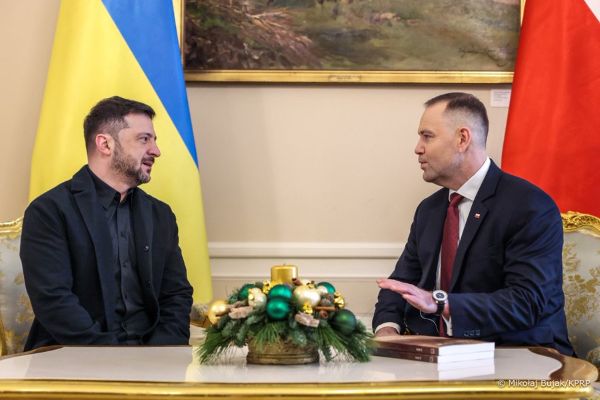
The Presidents of Ukraine, Volodymyr Zelenskyy, and Poland, Karol Nawrocki, met in Warsaw on 19 December during the Ukrainian president’s official visit, aimed at reinforcing the solidarity of their nations in the face of Russian aggression. During their discussions, they highlighted advancements in historical reconciliation, which have previously contributed to tensions in bilateral relations. This meeting underscored a valuable opportunity to enhance Polish-Ukrainian relations and maintain stability, irrespective of potential shifts in the political landscape in Warsaw.
Throughout his visit, Zelenskyy met with delegations from both countries. Following these discussions, a press conference was held featuring both leaders.
President Nawrocki paid tribute to the legacy of former President Lech Kaczyński, which has been upheld by his successor, Andrzej Duda. He reaffirmed Poland’s commitment to continued military and economic support for Ukraine, aiming to position Poland as a leading force in Central and Eastern Europe.
The statements from both leaders reflect a mutual dedication to establishing a robust and balanced strategic partnership. President Nawrocki also indicated that replacing Polish MiGs with Ukrainian drone technologies aligns with Polish policy, and he anticipates that this matter will be resolved upon completion of the necessary formalities.
Poland’s liberal government has demonstrated strong support for Ukraine, with Prime Minister Donald Tusk emerging as a prominent advocate for Kyiv in international discussions. However, the results of the recent presidential election indicate a potential return to power for the nationalist Law and Justice (PiS) party in 2027. Nawrocki, elected with PiS’s support, has refrained from publicly endorsing Ukraine’s efforts and notably did not visit Kyiv after his election. He has called for Ukrainians to express gratitude for the Polish assistance provided since Russia’s full-scale invasion in 2022, and he has said that he wouldn’t sign an eventual accession of Ukraine to the European Union. These positions align with the growing anti-Ukrainian sentiments being fostered by PiS and elements of the far right within Polish society.
Fortunately, President Nawrocki demonstrated that he understands what independence and sovereignty of Ukraine mean for Poland and the EU.
At a press conference on Friday, the president of Poland expressed approval of Ukrainian President Zelenskyy’s visit, stating that his presence in Warsaw was beneficial for both Poland and Ukraine while representing a setback for Moscow. He affirmed Poland’s commitment to supporting initiatives aimed at transferring frozen Russian assets to Ukraine, as well as advocating for further sanctions against Russia and measures to counter its shadow fleet. In response, President Zelenskyy indicated that Ukraine is prepared to share its expertise in drone defence and extend an invitation for Polish businesses to engage in the reconstruction of Ukraine.
“In strategic matters, our strategic cooperation in the field of security issues, Poland, Ukraine, countries of the region, countries filled with democratic values are together, and this has never been in doubt,” Nawrocki said.
Gratitude for Polish support
President Zelenskyy thanked Poland for its support, especially for backing a €90 billion interest-free loan from the European Union to help meet Ukraine’s military and economic needs over the next two years. He stated that if Russia prolongs the war, those funds will be used for defence, but if peace is achieved, the money will be dedicated to reconstruction.
Zelenskyy also addressed the deployment of Russia’s nuclear-capable Oreshnik missile system to Belarus, warning that it threatens several European countries, including Poland and Germany. He urged allies to impose sanctions on companies that produce components for the Oreshnik, though he noted no results have emerged yet.
Overcoming historical wounds
The two presidents emphasised cooperation on the exhumation of Polish victims buried in mass graves in Ukraine’s Volhynia region. During World War II, violent conflicts between Poles and Ukrainians resulted in significant civilian casualties on both sides, creating lasting tension between the nations, with Polish authorities estimating tens of thousands of Poles were murdered.
In January, Poland and Ukraine agreed to allow the exhumation of some Polish victims, a breakthrough. Exhumations have already taken place in Puzhnyky and Lviv-Zboiska, revealing at least 42 remains linked to the Volhynia massacres. Both sides granted permissions for further exhumations, although Nawrocki requested additional concessions from Ukraine.
During the meeting, Zelenskyy expressed readiness to expedite the process and respect both nations’ historical memories. Experts noted that after the Nawrocki-Zelenskyy meeting, there was a clear sense of unity and a reduction in divisive issues between Poland and Ukraine.
In Poland, the far-right camp, represented by several pro-Russia groups, including Konfederacja, criticised President Karol Nawrocki for refusing bilateral meetings with Budapest and eventually joining the Hungary-Slovakia pro-Moscow cooperation.
