
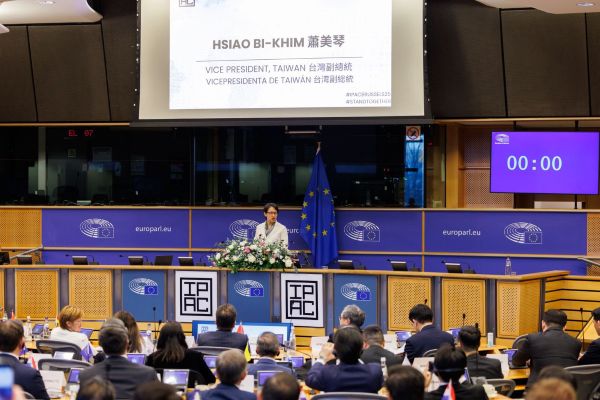
Taiwan’s deputy leader Bi-khim Hsiao has called on the EU to enhance security and trade relations with the self-governing island and support its democratic values in light of increasing pressures from China. In her address to approximately 50 lawmakers from around two dozen countries in Brussels, Hsiao encouraged collaboration on trusted supply chains and artificial intelligence (AI) technology.
“Peace in the Taiwan Strait is essential to global stability and economic continuity, and international opposition against unilateral changes to the status quo by force cannot be overstated,” Vice President Bi-Khim Hsiao told lawmakers assembled for a China-focused conference in the European Parliament building.
While the EU does not maintain formal diplomatic relations with Taiwan due to their adherence to a “One China” policy, both share foundational democratic principles and robust trade ties, opposing any military actions by China regarding Taiwan.
Hsiao highlighted the parallels between Taiwan’s cyberattacks and the hybrid threats faced by European nations since Russia’s invasion of Ukraine, urging the EU to create a reliable technology ecosystem with Taiwan.
“In an era marked by increasing fragmentation, volatility and rising authoritarianism, this gathering affirms something vital — that democracies, even when far apart, are not alone,” she added.
China’s mission to Europe criticised Hsiao’s presence, labelling it as “separatist activities” and expressing strong disapproval over her visit.
Recent military manoeuvres by China near Taiwan have increased, including daily joint drills. In response to growing security concerns, Taiwan’s President Lai Ching-te aims to expedite the development of the T-Dome air defence system and increase defence spending to 5% of the country’s GDP by 2030.
Hsiao’s visit was part of a conference organised by the Inter-Parliamentary Alliance on China, which advocates for unified international action on China-related challenges. The trip remained confidential due to security risks, following reports of Chinese agents plotting to intimidate Hsiao during her earlier visit to the Czech Republic. Hsiao reaffirmed her commitment to advocating for Taiwan’s interests despite these threats.
According to The Associated Press, Ben Bland, the director of the Asia-Pacific program at the London-based think tank Chatham House, recently stated in an analysis that, despite the absence of formal diplomatic relations, the European Union and Taiwan have significant opportunities to enhance their cooperation for mutual benefit, particularly in the context of the escalating rivalry between the United States and China. He emphasised that any conflict concerning Taiwan could have a far more severe impact on Europe than Russia’s invasion of Ukraine, given Taiwan’s pivotal role in global semiconductor and electronics supply chains.
Bland noted, “European nations cannot stop Beijing from squeezing Taiwan harder,” Bland wrote. “But they can help to preserve and even increase Taiwan’s global connections, and share lessons in how to stay resilient.”
This article used information from The Associated Press
