
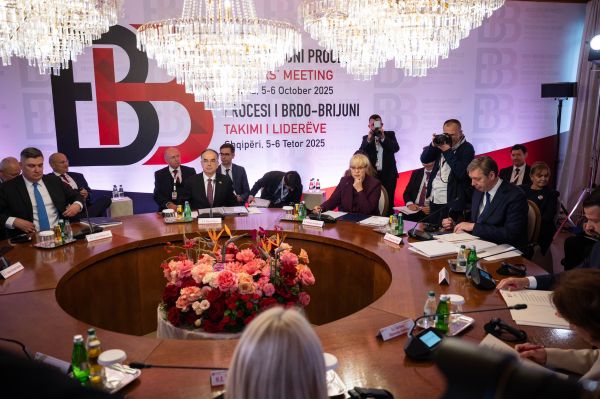
Leaders from the Western Balkan countries convened on Monday to reaffirm their commitment to a collective European future, emphasising the importance of deepening cooperation and accelerating reforms to facilitate the region’s integration into the European Union. This annual gathering took place in Golem, Albania, situated 50 kilometres west of the capital, Tirana.
The meeting is part of a diplomatic initiative established by EU members Slovenia and Croatia in 2013 to support the EU’s enlargement, which aims to include the Western Balkans, comprising Albania, Bosnia and Herzegovina (BiH), Serbia, Montenegro, North Macedonia, and Kosovo.
In a joint declaration, the leaders articulated their “shared vision for the European perspective of our entire region.” They stated, “We reaffirm our commitment to supporting European integration and fostering inclusive regional cooperation, to establish a peaceful, strong, stable, prosperous, and united Europe.”
However, while these countries are working towards EU membership, they currently occupy different stages within this process; Montenegro and Albania are further ahead, whereas Serbia, Bosnia and Herzegovina, Kosovo, and North Macedonia are progressing more slowly.
The EU’s readiness to consider new members has increased significantly since the war in Ukraine began in February 2022. There are concerns that this conflict, along with Russia’s growing confrontation with the West, may have repercussions for a region still healing from its own past conflicts. The leaders welcomed the introduction of a €6 billion growth plan aimed at facilitating necessary reforms in the area.
Slovenian President Natasa Pirc Musar emphasised that the #BrdoBrioni Process serves as a platform for trust and partnership, stating, “It is a space where we build the European future of our region. I am convinced that only through our collective efforts can we make this future a reality—a future that will bring stability, prosperity, and, fundamentally, new opportunities for our citizens.” She also urged the European Union to expedite the membership process, highlighting that “the security and peace of Europe are at stake.”
This largely ceremonial event was led by Albanian President Bajram Begaj, alongside President Pirc Musar and Croatian President Zoran Milanovic. Additionally, members of Bosnia’s tripartite presidency, as well as the presidents of Kosovo, Montenegro, North Macedonia, and Serbia, participated in the discussions.
The Brdo-Brijuni Process, named after Brdo pri Kranju in Slovenia and the Brijuni Islands in Croatia—both symbols of reconciliation and diplomacy—aims to strengthen political dialogue and promote reconciliation following the conflicts of the 1990s, addressing ongoing tensions, particularly between Serbia and Kosovo.
(This article used information from the Associated Press)
