
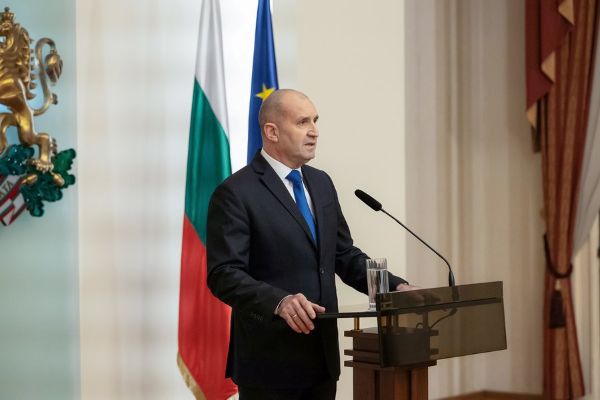
Bulgarian President Rumen Radev announced on Monday his intention to resign, sparking speculation about the potential formation of his own political party to contest the upcoming parliamentary elections. Following the resignation of the previous government last month, Bulgaria is now preparing for the eighth parliamentary election in four years.
President Radev, who was first elected in 2016 and re-elected in 2021 with the support of the Socialist Party, was expected to hold the largely ceremonial position until the end of 2026.
The president has previously expressed an interest in contesting the anticipated election, which comes on the heels of protests that led to the resignation of a centre-right government. Radev has been a vocal critic of the coalition government led by Rosen Zhelyazkov and has demonstrated support for the protests that emerged in early December. Furthermore, he has expressed scepticism about Bulgaria’s recent decision to adopt the euro. He has also sided with the Kremlin on the ongoing conflict in Ukraine and the associated sanctions against Russia.
In addition, President Radev has frequently considered establishing his own political party to promote stability and combat corruption in one of the European Union’s least affluent and most corrupt nations. He has delivered a populist message, asserting that “today’s political class has betrayed the hopes of the Bulgarian people.”
“The battle for the future of our homeland lies ahead, and I believe we will face it together with all of you — the worthy, the inspired, and the unyielding! We are ready. We can, and we will succeed!” Radev said in his address.
President Radev’s recent resignation marks a historic moment as he becomes the first head of state to resign in Bulgaria’s post-communist era. This decision arises amid a prolonged political crisis in the country, which is a member of the European Union and NATO. Last month’s large-scale anti-corruption protests led to the resignation of the governing coalition led by the centre-right GERB party. Efforts to form a new government in the current parliament have been unsuccessful, prompting preparations for the eighth parliamentary election since 2021.
A profound political crisis
President Radev’s decision to step down, widely anticipated in Bulgaria, comes amid a prolonged political crisis. The fragmented nature of parliament has led to a series of elections without the establishment of stable majorities or enduring coalitions. The previous government, which had been in power for nearly a year, resigned in December amid widespread protests over a new budget and corruption-related issues.
In the meantime, Radev has been responsible for appointing interim governments, which has increased his visibility and potentially his political aspirations, according to analysts and Western diplomats. He has expressed intentions to participate in the forthcoming elections. He has consistently opposed Boyko Borissov, the leader of the GERB party, as well as Delyan Peevski, a politician and oligarch currently under sanctions from the US and UK. Peevski’s party, the Movement for Rights and Freedoms – New Beginning (DPS-NN), has regularly supported the outgoing GERB-led coalition.
Can Radev make an essential change?
While multiple opinion polls regarding the upcoming elections are available, none currently feature a party led by Radev. A recent survey indicated considerable support for a new political party and significant mistrust towards the existing political system. Analysts suggest that, although Radev has popular support, he is unlikely to secure an outright majority if he were to establish a new party and participate in the elections. It is more probable that he would need to seek a coalition partner, potentially the liberal PP-DB (We Continue the Change – Democratic Bulgaria) party.
However, the PP-DB maintains a clear pro-European Union stance concerning the war in Ukraine, in contrast to Radev’s Kremlin-friendly position against sending military aid, characterised as “doomed.” Additionally, the liberal party has championed the introduction of the euro in Bulgaria.
The results of the 2024 parliamentary elections revealed a 9-party parliament, underscoring the country’s ongoing political crisis. The new parliament includes far-right and right-wing populist parties represented by four groups: the extremist Revival, There is Such a People (ITN), MECh, and Velichie, which collectively hold 71 seats. Boyko Borisov’s GERB-SDS, a member of the European People’s Party (EPP), secured the most seats with 66 out of 240. The Renew Group member PP-DB came in second with 36 seats, followed by the extremist Revival with 33 seats and the DPS-NN with 29. The Socialist Party (BSP-OL) obtained 19 seats, while both the Alliance for the Rights and Freedom (APS) and the ECR-member ITN each garnered 17 seats. MECh secured 11 seats, while Velichie obtained 10.
According to polls conducted in December 2025, four parties—GERB-SDS, PP-DB, Revival, and DPS-NN—are expected to increase their seat totals. In contrast, BSP-OL is projected to maintain or slightly enhance its influence. MECh may also experience modest gains. Two parties—APS and ITN—are striving to meet the 4% threshold for parliamentary representation, but current polling suggests they may face challenges. Additionally, Velichie is anticipated to remain outside the next parliament.
It is noteworthy that these opinion polls did not account for the potential emergence of a new party led by former President Radev and the dynamics it could introduce. Given that Radev was elected President with substantial support from the Socialist Party and holds pro-Russian, Eurosceptic views, the formation of his own party could pose a significant challenge to the Socialist Party and subsequently attract the far-right electorate.
