
The leaders of France and the UK will meet representatives from several countries—excluding the US—on Friday to discuss reopening the Strait of Hormuz, a vital oil route disrupted by the ongoing US-Israeli conflict with Iran.
Since the war began on 28 February, Iran has effectively closed this narrow strait, which usually facilitates one-fifth of the world’s oil. The US is not participating in the Strait of Hormuz Maritime Freedom of Navigation Initiative.
French President Emmanuel Macron emphasised that the mission to ensure safe passage will be “strictly defensive” and limited to non-belligerent countries, and will be activated only when conditions permit. Alongside British Prime Minister Keir Starmer, Macron aims to increase diplomatic and economic pressure on Iran, which Starmer claims is “holding the world’s economy to ransom.” Additionally, President Donald Trump‘s announcement of a blockade on Iranian ports has further escalated economic risks.
“The unconditional and immediate reopening of the Strait is a global responsibility, and we need to act to get global energy and trade flowing freely again,” Starmer said before the meeting.
Military planning meetings
France and Britain are leading military planning meetings, akin to the “coalition of the willing” formed for Ukraine’s security during a potential ceasefire. French military spokesman Colonel Guillaume Vernet stated that the mission is still being developed.
Macron’s office emphasised that contributions will vary according to each participant’s capabilities, and that measures for safe passage through the strait will depend on post-ceasefire security. An anonymous official noted that ship operators need proper resources to protect their vessels, which may include intelligence, mine-clearing, military escorts, and communication procedures with coastal states.
Sidharth Kaushal from the Royal United Services Institute suggested that mine-clearing and establishing a maritime threat warning system will likely be the coalition’s main responsibilities, rather than deploying warships to escort commercial tankers.
“You need huge numbers of vessels for that sort of thing, which nobody has,” he said.
Iran expert Ellie Geranmayeh, deputy head of the Middle East and North Africa programme at the European Council on Foreign Relations think tank, said mine-clearing is an area where European countries and their partners could play a role.
“They would be a better party to do this than the United States, because once you have U.S. military doing this and lingering on Iranian shores, it creates a potential arena for Iran and the U.S. to have miscalculations and get back into a sort of military tension,” she said.
Talks involve dozens of countries
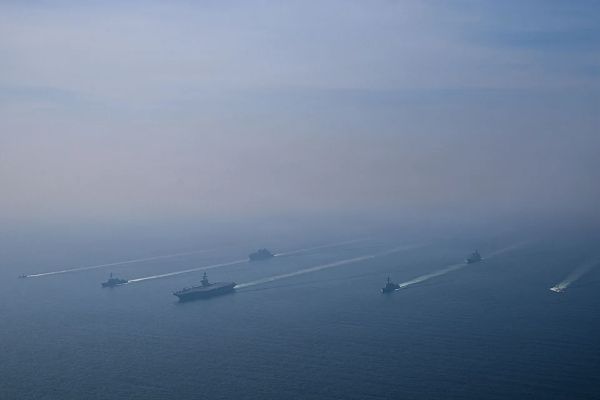
Britain is considering deploying mine-hunting drones from the RFA Lyme Bay for a mission in the Strait of Hormuz, highlighting the Royal Navy’s reduced capabilities, which currently include only the destroyer HMS Dragon in the eastern Mediterranean. In contrast, France has sent its nuclear-powered aircraft carrier, a helicopter carrier, and several frigates to the region.
More than 40 nations have participated in meetings led by France and the UK, but fewer are expected to commit military resources. Approximately 30 countries, including those from the Middle East and Asia, are set to attend Friday’s talks, although the full list is not disclosed. German Chancellor Friedrich Merz and Italian Premier Giorgia Meloni will attend in person.
This operation partially responds to President Trump’s criticism of allies for not joining the war and his claims that reopening the Strait is not America’s job. The president has called allies “cowards,” said NATO “wasn’t there when we needed them”, and told Britain: “You don’t even have a navy.”
“I imagine there’ll be some desire on the part of many European states, and potentially Canada, to demonstrate the ability to provide security in a way that’s distinct from if not completely separate from the US and which also demonstrates a capacity for independent action,” Kaushal said.
“How many states actually have spare capacity to offer to this is a pretty open question.”
This article used information from The Associated Press.
