
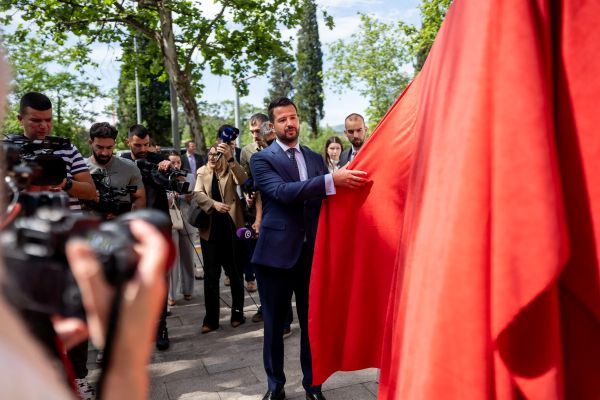
Montenegro is commemorating 20 years of independence this week, marking its departure from a union with Serbia. Over the past two decades, the country has experienced significant transformation, including its accession to NATO. Montenegro is now strategically focusing on its next objective: full integration into the European Union, of which it has been a candidate since 2010.
In an interview with The Associated Press, President Jakov Milatović emphasised NATO membership as a pivotal milestone. He expressed confidence that Montenegro, with a population of 623,000, will successfully pursue its ambitious agenda of becoming the next member of the 27-member EU by 2028. The “28 by 28” motto has been prominently displayed on one of the national airline’s aircraft.
“I am optimistic that we can achieve it,” Milatović remarked from his office in Podgorica, the capital city. This week, a series of concerts and various celebrations are being held in Podgorica and other towns throughout Montenegro, a nation celebrated for its stunning Adriatic Sea coastline and magnificent mountains.
A front-runner for EU accession
Montenegro is positioned as a leading candidate for European Union (EU) membership among the six Western Balkan countries, each at varying stages of the accession process. Additional nations, such as Ukraine, also aspire to future EU membership. The EU has formed a working group to draft an accession treaty for Montenegro, signalling that membership remains attainable.
In early June, EU officials are expected to reaffirm this commitment during a meeting in Tivat, a coastal town in Montenegro, with leaders from the Western Balkan candidate nations, including Albania, Bosnia and Herzegovina, North Macedonia, Serbia, and Kosovo.
President Milatovic has indicated that public support for EU integration in Montenegro is substantial, with approximately 80% of citizens in favour. Nevertheless, he stressed the necessity of completing the nation’s democratic and economic reforms, noting that the pace of these reforms is “entirely up to Montenegro.” This current situation stands in stark contrast to two decades ago, when Montenegro decided to secede from the State Union of Serbia and Montenegro, which itself was one of several successor states of the former Yugoslavia.
After independence from Serbia
On 21 May 2006, Montenegro held a referendum to determine its future direction, reflecting a divide between those advocating independence and those supporting continued union with Serbia. This decision emerged in the context of a tumultuous decade marked by wars and NATO intervention in 1999, which aimed to stabilise the situation in Kosovo. The referendum resulted in 55.5% of voters opting for independence.
The decision to separate from the joint state was contentious, particularly given Montenegro’s historical connections to Serbia. Approximately one-third of Montenegrins identify as Serbs, and the two nations share commonalities, including the Orthodox Christian faith, similar languages, and centuries-old alliances.
The independence movement was spearheaded by Milo Djukanovic, Montenegro’s long-serving leader, who facilitated the country’s entry into NATO and fostered a shift away from reliance on Russia, another historical Slavic ally.
Djukanovic stated, “Twenty years ago, the citizens of Montenegro took decision-making into their own hands, which laid the foundation for our development.” He further emphasised, “Significant progress was achieved when the country became a member of NATO in 2017.” He underscored that NATO membership is particularly vital for a small country like Montenegro, serving as a crucial security guarantee for the nation’s independence and statehood.
Reforms and corruption are still a challenge
Montenegro has been a candidate for European Union membership since 2010. Yet, it continues to encounter significant challenges on its path to integration, as noted by former European Integration Minister Jovana Marovic. The primary focus is on strengthening state institutions. “What has been lacking over the past 14 years must now be accomplished in just six months,” she remarked. “It is indeed a demanding endeavour, but progress is being made.”
For Montenegro’s citizens, the economy and living standards are paramount concerns. In tandem with necessary democratic reforms, Montenegro has adopted the euro as its currency; however, the economy remains relatively small and heavily dependent on tourism. Zorana Popivoda, age 28, expressed pride in the nation’s restored independence, while also highlighting the challenges faced: “Upon entering a store, one often finds that purchasing options are exceedingly limited.”
President Milatovic, 39, who has a background in economics, has criticised previous Montenegrin authorities for not taking sufficient action in the early years of independence to advance democratic reforms and combat organised crime and corruption. “Over the past 20 years, it is clear that the country has experienced progress,” he stated, “yet there have also been numerous missed opportunities.”
This article used information from The Associated Press.
