
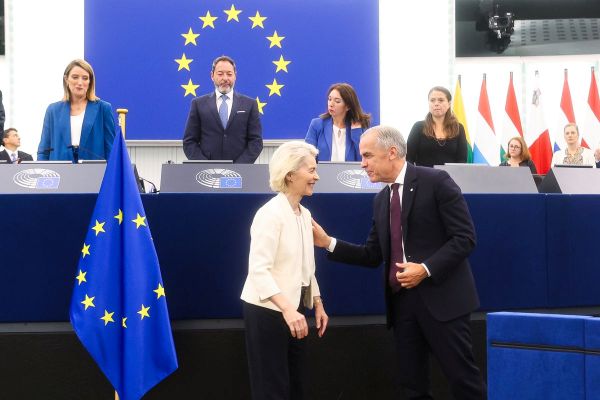
European Commission President Ursula von der Leyen proposed making Canada the EU’s first associate member, responding to US President Donald Trump‘s threats that have strained Canada-US relations. Canada aims to reduce its reliance on the US, which accounts for around 70% of its exports. Prime Minister Mark Carney has sought a “unique alliance” with the EU.
In her State of the European Union address, von der Leyen stated that Canada and the EU would build on their existing free trade agreement, the Comprehensive Economic and Trade Agreement (CETA), through a broader “Alliance for the Future” focused on shared prosperity and economic security. She highlighted their common democratic values, stating, “Above all, dear Mark, Europe and Canada believe in democracy.” Carney is set to address the European Parliament on Thursday.
Canada seeks a relationship just short of membership
A Canadian official recently told The Associated Press that Ottawa is exploring a closer relationship with the EU that stops short of full membership. Canada aims to establish an arrangement that would allow its citizens to live and work in Europe without visas as part of a broader partnership.
Jonathan Wilkinson, Canada’s ambassador-designate to the EU, noted that discussions about associate membership had occurred before Ursula von der Leyen’s speech. While Canada is not seeking full membership to avoid relinquishing sovereignty, it aims to strengthen ties with the EU in a way that reinforces Canadian sovereignty.
Carney’s office welcomed von der Leyen’s proposal, highlighting Canada’s intent to deepen its relationship with the EU and go beyond CETA.
Canada already in EU’s defence procurement programme
Ursula von der Leyen announced that the expanded partnership with Canada will include areas such as advanced manufacturing, technology, defence production, the Arctic, energy, critical minerals, batteries, artificial intelligence, quantum computing, cybersecurity, and economic security.
Because Canada’s potential associate membership in the EU is unprecedented, no framework exists for how it would work.
“This is a partnership not against anyone else, but for our common strength,” she said. “In short, we want to bring the relationship with Canada to the highest level possible.”
Minister Wilkinson said Ottawa and Brussels are focusing on the substance of the relationship rather than the terminology. He expects the specifics to become clearer at the Canada-EU summit in October, where an announcement may be made.
Currently, any steps towards EU membership require unanimous approval from the 27 member countries. Associate membership has been suggested for Ukraine and post-Brexit Britain, but no concrete actions have been taken.
Canada and EU towards a broader alliance
The relationship between Canada and the European Union has reached a crucial point where both sides must move beyond rhetoric to establish a more substantial partnership, said Tobias Cremer, a German member of the European Parliament.
He emphasised the need for a more ambitious arrangement than mere trade or defence agreements, advocating for a holistic strategic alliance between Canada and the EU.
Cremer suggested that existing frameworks like CETA could be better utilised and expanded. He noted that geopolitical factors are increasingly driving the case for closer ties.
This year, Canada became the first non-European country to join the EU’s 150-billion-euro SAFE defence programme, allowing Canadian companies access to joint procurement as Europe enhances its defence readiness.
Iratxe García Pérez, president of the Socialists & Democrats group in the European Parliament, praised Carney for his courage in confronting Donald Trump. She highlighted the necessity of allies to defend sovereignty and international law. Carney indicated that discussions will intensify at the upcoming Canada-EU summit in late October.
Trump’s politics accelerate Canada’s shift towards Europe
Canada has retaliated against US tariffs and rejected trade terms that Carney claims threaten its sovereignty. In contrast, the EU has reached a trade agreement with the US that sets a 15% tariff ceiling on most EU exports while eliminating tariffs on US industrial goods.
This divergence has influenced Carney’s push for closer European ties. In a notable speech at the World Economic Forum in Davos, he encouraged middle powers to unite and strengthen their influence amid great-power rivalry. Carney’s remarks drew criticism from Trump, and von der Leyen’s outreach to Canada could reignite tensions.
“When we only negotiate bilaterally with a hegemon, we negotiate from weakness. We accept what is offered,” Carney said.
“This is not sovereignty,” he said. “It is the performance of sovereignty while accepting subordination.”
This article used information from The Associated Press.
