
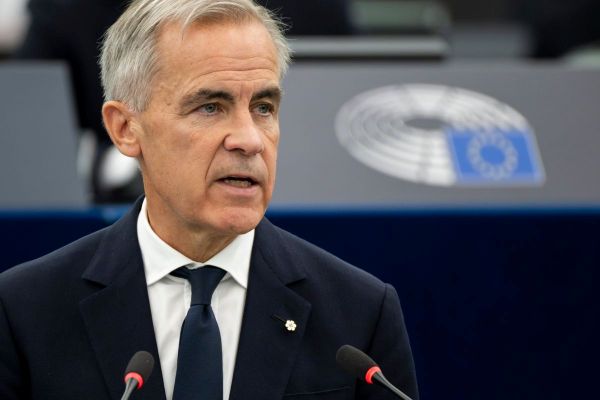
Canadian Prime Minister Mark Carney on Thursday supported Canada becoming the first associate member of the European Union. He argued that closer ties with Europe would help protect Canada’s markets and sovereignty from outside control.
In his speech to the European Parliament, Carney highlighted the need for cooperation between Europe and Canada, especially given the increasingly strained relationship with the United States. He cited Trump’s tariffs and demands as reasons for Canada to reduce its dependence on its neighbour and seek stronger economic and political ties with Europe.
Carney welcomed European Commission President Ursula von der Leyen‘s proposal for associate membership, noting that the details still need to be defined. He suggested deeper integration in areas such as trade, defence, and technology to reduce vulnerability to external pressures.
“We do not seek power to dominate others,” he said. “On the contrary, we are pursuing resilience so that no one can control our open markets, impair our sovereignty, threaten our territorial integrity, or undermine our freedoms, our democracies, our rule of law.”
After his address, Carney received a warm welcome, with lawmakers approaching him for handshakes and selfies and giving him a standing ovation. One parliamentarian had donned a Canadian hockey jersey.
Europe’s first associated member
On Wednesday, Ursula von der Leyen proposed designating Canada as the European Union’s first associate member. This status currently does not exist in the EU’s treaties and would require formal establishment. She said Europe wants to elevate its relationship with Canada to “the highest level possible.”
Mark Carney, present in the front row of the chamber, acknowledged the proposal with a nod and rose to embrace von der Leyen.
Von der Leyen added that Canada and the EU should go beyond their existing free trade agreement and establish an “Alliance for the Future,” which encompasses a “common prosperity and economic security space.” PM Carney is scheduled to host EU leaders for a summit in Montreal on October 29-30, where both parties are anticipated to delve into discussions regarding this proposed new relationship.
Canada currently directs about 70% of its exports to the United States, exposing it to potential tariff impacts. In response, Ottawa has taken retaliatory measures and has declined demands that Carney says threaten Canadian sovereignty. In contrast, Europe has chosen a different strategy, accepting tariffs of up to 15% on most exports to the US rather than retaliating.
Trump threatens heavy tariffs on EU
US President Donald Trump described the proposed EU arrangement as a possible “hostile act” and threatened heavy tariffs on Europe if he perceived unfriendly intentions.
In response, Carney affirmed that Canadians reject external attempts to dictate their choices.
“Canadians are united that nobody is going to tell us what language we speak. No one is going to dictate our culture or with whom we can strike agreements internationally,” Carney said.
Carney urges ‘middle powers’ to resist economic coercion
Carney has urged middle powers to resist economic coercion, stating at the World Economic Forum in Davos that negotiating individually with a dominant power leads to weakness. Trump rebuked him the next day.
Jonathan Wilkinson, Canada’s ambassador-designate to the EU, said that Ottawa wants to strengthen its ties with Europe while maintaining independence. Canada has already become the first non-European country to join the EU’s €150-billion SAFE defence procurement programme, which provides access to joint procurement as Europe boosts its defence spending.
Additionally, both sides are exploring closer cooperation in energy, critical minerals, artificial intelligence, and digital trade. Carney noted that any enhanced partnership with the EU would be debated in Canada’s Parliament and put to a final vote.
“The policies and rhetoric of the Trump administration are clearly pushing both Canada and the EU to imagine a world without strong US leadership and to act accordingly,” said Daniel Béland, a political science professor at McGill University in Montreal.
Nelson Wiseman, a professor emeritus at the University of Toronto, explained that Europeans view Canada as a country that understands the United States because of its strong economic and political ties. He noted that Carney’s readiness to resist Trump, instead of quickly accepting Washington’s demands, has reinforced this perception.
“Carney’s shrewdness in dealing with Trump has captured Europe’s attention,” Wiseman said.
This article used information from The Associated Press.
