
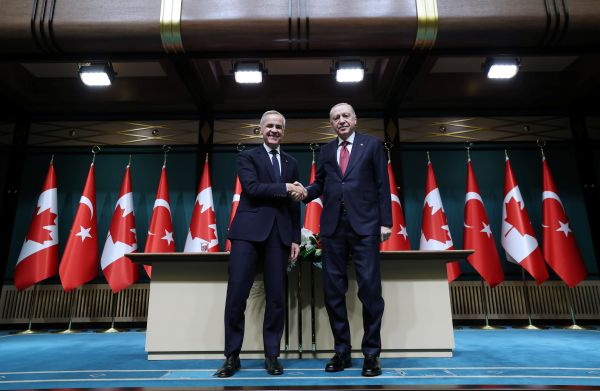
On Thursday, Canadian Prime Minister Mark Carney and Turkish President Recep Tayyip Erdoğan announced a “strategic partnership” to enhance collaboration between the two countries and reduce Canada’s reliance on the United States.
During the event, the leaders witnessed the signing of three cooperation agreements addressing key sectors, including defence, transportation, and energy. They also announced the start of negotiations for a free trade agreement.
President Erdoğan remarked, “We have taken a historic step toward the future of our relations. Elevating our relationship to the level of a strategic partnership will not be merely symbolic; it will have tangible implications.”
In response to ongoing trade tensions with the US, marked by tariffs on Canadian goods imposed under President Donald Trump, Prime Minister Carney is actively pursuing diversification of Canada’s international partnerships. This development comes as Canada has taken retaliatory measures while navigating Trump’s statements, which have raised concerns about Canada’s sovereignty.
“No country, whatever it’s blessed with, no country builds strength alone,” Carney said. “The most resilient countries bring together complementary strengths, with trusted partners.”
Carney is undertaking the first bilateral visit to Turkey by a Canadian prime minister, after visiting Ankara in July for the NATO summit. He is scheduled to travel to Istanbul on Friday for discussions with Turkish business groups.
In a positive development reflecting strengthening ties between the two countries, Canada lifted its 2024 export ban on weapons to Turkey. This ban had been instituted in response to Turkey’s military incursions into Syria and its support for Azerbaijan during the conflict with Armenia, which included supplying equipment that incorporated Canadian-made components.
“Allies must be able to rely on each other for equipment and capabilities that keep us safe,” Carney said. “Today’s new agreement on defence industry partnership will connect Canadian and Turkish companies to work together, creating good jobs at home, export opportunities abroad, greater security for our citizens and contributing to a stronger NATO alliance,” he added.
Erdoğan said Turkey and Canada aim to increase annual bilateral trade from about $3 billion to an initial target of $5 billion, with a long-term goal of $10 billion. As part of this collaboration, Turkey plans to build a second nuclear power plant on its Black Sea coast, in addition to the one Russia’s Rosatom is currently building on the Mediterranean coast. Canada has expressed interest in participating in this project.
Amnesty International recently urged Carney to address human rights concerns during his visit to Turkey. This visit comes amid a significant crackdown on opposition voices within the country. Authorities have made arrests involving journalists and activists, including those advocating for LGBTQ rights, and have appointed a government administrator to oversee a prominent opposition-aligned television station. Istanbul Mayor Ekrem İmamoğlu, considered a leading rival to Erdoğan, has been imprisoned for over a year on corruption charges he denies. Additionally, hundreds of members of the opposition party and elected officials have been detained in what critics characterise as an attempt to undermine Turkey’s largest opposition group.
While Erdoğan’s government asserts that Turkish courts operate independently, Amnesty’s Turkey director, Ruhat Sena Aksenir, articulated concern regarding the judiciary’s role in suppressing dissent. She remarked, “As the judiciary is increasingly used to silence dissent and suppress critical voices, a clear message emerges: speaking out can come at a heavy price.”
Aksenir further emphasised the importance of prioritising human rights in negotiations, stating that “sustainable partnerships depend on accountability and respect for the rule of law.” Notably, Carney did not publicly address these human rights issues during his visit.
This article used information from The Associated Press.
