
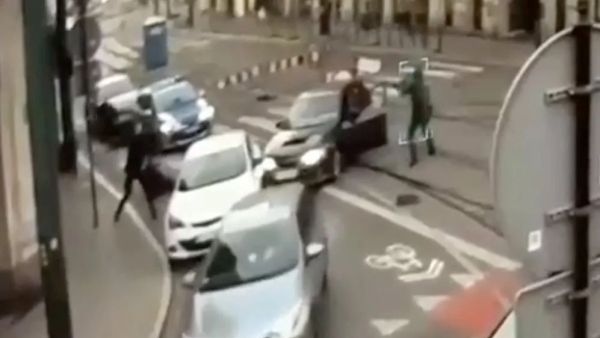
Disinformation campaigns orchestrated by far-right and extremist parties in Poland and Russia seek to obscure the fact that 25-year-old Michał O., the perpetrator of the massacre in Kraków, is affiliated with far-right extremist ideology. The dissemination of misinformation stems from the active conspiracy theory industry within the Polish far-right, including several members of the Law and Justice party (PiS), who aim to misrepresent the attacker as a member of the LGBTQ+ community, a far-left militant, or of Ukrainian descent. Furthermore, extremist leaders from European far-right parties are amplifying these misleading narratives, aiming to destabilise Poland.
The Polish far-right has reacted strongly following the emergence of evidence confirming Michał O.’s connections to far-right extremism. In a period of heightened tension, well-known far-right figures have accused government ministers of spreading false information, particularly after Interior Minister Marcin Kierwiński labelled Michał O. an “ultranationalist.”
“Following the terrorist attack in Kraków, we are confronting a significant wave of disinformation. This is not coincidental; the proliferation of false information, bots, and efforts to create discord among the population often arise when society is most vulnerable to fear and emotion,“ stated Deputy Prime Minister and Minister of Digital Affairs Krzysztof Gawkowski in a post on X on 8 November.
“We are observing a marked increase in the circulation of false and unverified information,“ Gawkowski added.
On the evening of 7 November, the Deputy Prime Minister convened an emergency meeting to address these organised disinformation efforts. The meeting included Dariusz Standerski, Deputy Minister of Digital Affairs, and Paweł Olszewski, MP and Deputy Minister of Digital Affairs, who focused on cybersecurity. A team from the Centre for Countering Disinformation supported them and is actively monitoring the information landscape for disinformation related to the terrorist attack in Kraków. All identified disinformation messages are being reported to the platforms’ contact points through established rapid-response channels.
Conspiracy theories to the service of Moscow
The disinformation attack against Poland involved anonymous bots and was supported by far-right figures, both domestically and internationally. The NASK Disinformation Analysis Centre reported over 2,000 accounts spreading false narratives on social media that were flagged for moderation. Many of these accounts were automated bots posting content in Polish, English, French, and Dutch, with some linked to Russia through Cyrillic characters or direct references to the Russian Federation.
As verified information emerges from public institutions, the initial narratives following the events in Kraków are fading, though new false narratives continue to arise. Disinformation mentions peaked around 6:00 PM on Saturday, 7 November, reaching over 200 million views before declining. The topic gained some traction again the next morning.
Still, current disinformation posts are not reaching the same audience as before, mainly because they are being shared by users with limited influence. Major disinformation attacks are currently being systematically addressed and are generating less engagement.
According to the NASK, the main disinformation narratives that appeared online after the attack in Kraków targeted the Polish government, the EU and Ukraine.
1. The Polish government orchestrated the attack, with the European Union involved in its execution. Despite being absurd, this narrative gained significant traction because of certain groups’ hostility toward the EU, potentially reaching up to 200 million views.
2. The government staged the attack to justify cancelling the Independence March, gaining 5.6 million views on 7 November. However, its popularity has since declined.
3. The shooter was a soldier, and this narrative quickly gained attention due to his uniform, reaching nearly 18 million views. However, its popularity faded rapidly as denials about the incident surfaced.
4. A connection between the Kraków shooting and the protests at the Constitutional Tribunal. Initially, this narrative attracted significant attention, reaching up to 14 million views, but has since diminished. It was based on inaccurate claims about inadequate emergency services at the scene.
5. The initial claim was that Ukraine organised the attack or that the perpetrator was Ukrainian. This narrative faded once security services confirmed the attacker’s nationality. Attempts were then made to spread disinformation, suggesting the attacker was a mercenary for the Ukrainian army.
Far-right assists disinformation
In Poland, MEP Ewa Zajączkowska attacked Minister Marcin Kierwiński for his comments regarding the circumstances surrounding the tragic attack in Kraków.
“The award for the most vile hyena, feeding off the tragedy and attack in Kraków, goes to Minister Kierwiński. He has just come out for a press conference and, at a time when the victims’ families are mourning their loved ones and more people are fighting for their lives in hospital, he blurted out that ‘there are many indications that the attacker was fascinated by far-right ideologies… To cynically exploit such a tragedy for political gain, you have to sink to the absolute bottom. Kierwiński, you are disgusting,“ the MEP, known for her vulgarity, posted on X.
In a separate statement, Anita Czerwińska, a member of the Polish Sejm and former spokesperson for the PiS party, suggested a connection between the attacker and a perceived phantom LGBT movement. She expressed concerns about the government’s quick response in highlighting the attacker’s alleged connections to far-right ideologies while seemingly downplaying any potential links to an LGBT identity.
Janusz Korwin-Mikke, a notable figure within the Polish right-wing extremist community and former MEP, provided a simplified explanation of the incident. He highlighted the background of the suspect and criticised various commentators for labelling the event a “terrorist attack,“ suggesting that more information should be gathered before jumping to conclusions.
Furthermore, George Simion, leader of the neofascist Alliance for the Union of Romanians (AUR) party in Romania, questioned Minister Kierwiński’s portrayal of the perpetrator’s ideological orientation. He argued that the suspect held extreme left-wing beliefs, accusing the Polish official of misrepresenting the facts surrounding the attack.
This situation reflects the ongoing challenges of addressing misinformation and political narratives after tragic events.
Government warns about disinformation’s real risks
“We are seeing increased activity involving the circulation of false and unverified information,“ Minister Krzysztof Gawkowski said.
“I would like to point out that images from the scene that have been altered using artificial intelligence are also appearing online. Sharpened images are very often misleading. Sharing and commenting on such images is undesirable and amplifies disinformation. We ask everyone to check the sources of information appearing online carefully,“ the minister added.
The Ministry warns that disinformation consists of false or misleading content, such as posts, articles, comments, videos, or audio recordings. It aims to incite fear, undermine trust in public institutions, and polarise society, contributing to Poland’s destabilisation and social divisions. False information on social media is particularly dangerous because of the sheer number of sources and algorithms that prioritise emotional content. To protect against disinformation, citizens should verify the source of information, especially during rapidly evolving events, and rely on reliable sources such as public institutions.
