
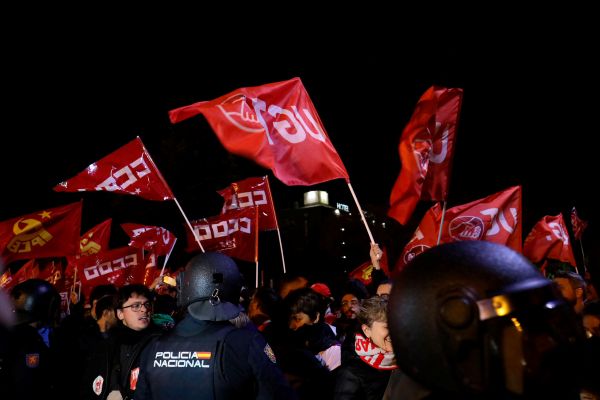
Spain is bracing itself for the first general strike in 14 years as new general elections loom, and both political sides hope to capitalise on the protest.
The strike is impacting public transport and factories across the country, while many schools and universities are either closed or working at minimal capacity. The strike also coincided with an ongoing, month-long strike by local schools in Madrid for better working conditions.
According to the main unions supporting the strike, UGT and CCOO, there was 90% participation in the automotive and port sectors, 85% in the meat industry, 82% in waste collection, and 75% in the energy sector.
The general strike had the official slogan “Salaries. Housing. Prices”, with the housing crisis being cited as the most pressing issue for most Spaniards.
Rents doubled in the last decade, and purchase prices have also risen, making it almost impossible to become homeowners. Activists have been pushing for a slate of new measures, such as eliminating tourist apartments, cracking down on real estate speculation, and providing more protection for renters, while unions are calling for government intervention in the housing market.
The housing crisis gained national notoriety over the case of the 87-year-old woman Maricarmen, who was forcefully evicted from her apartment after rent increases. The woman died shortly after her eviction. The case created public anger and indignation. Activists demanded a strike, soon backed by UGT and CCOO.
The anger over the case also spilt over into national politics. In early October, Spanish Prime Minister Pedro Sánchez pushed emergency measures to limit evictions and protect renters. Still, the opposition refused to ratify them, prompting Sánchez to call for snap elections at the end of November. He and his centre-left PSOE party have been hoping to use the housing crisis as a springboard for the campaign.
However, a massive train collision that killed 69 people on 28 October halted the momentum built over the issue. Sánchez and his allies now hope the strike could put housing back in the headlines.
Housing has also been a topic where Sánchez and other left-wing parties have been strong, while the centre-right People’s Party (PP) and far-right Vox opposition have dismissed it. Both oppose any government intervention to limit rents, tourist housing, or strengthen tenants’ rights. They have been framing the strike as an electoral one, pushed by unions working in Sánchez’s favour to keep him in power.
Both PP and Vox are on the sidelines of the strike, and according to professor Oriol Bartomeus, they may be hoping it turns violent. Bartomeus, who is a professor of political science at the Autonomous University of Barcelona, was interviewed by the Associated Press. He said that if there are clashes with the police and destruction of property, as has happened in France, both PP and Vox could make headlines about the chaos rather than the issues, presenting themselves as the party that could bring back order.
