
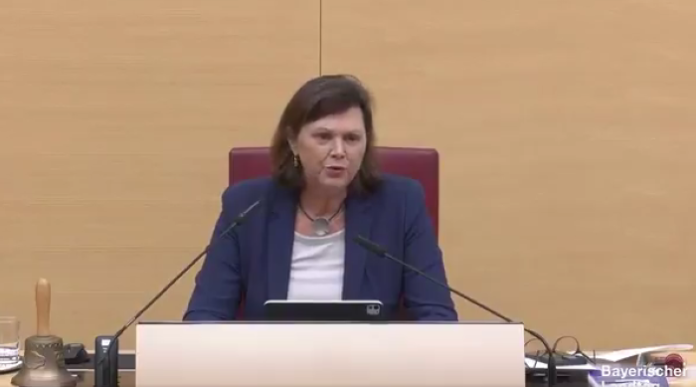
Germany is on the verge of electing its first female president, as Chancellor Friedrich Merz‘s party, the Christian Democratic Union (CDU), has nominated Ilse Aigner, a centre-right politician with broad appeal among liberals, to serve as head of state next year.
Aigner presented herself on Monday as a unifying figure in an increasingly polarised country, saying she aspires to embody a “strong centre.” She emphasised that the broad political support developing for her candidacy serves as “an important signal against populist and extremist forces” within Germany.
The new head of state will be elected on 30 January when a special parliamentary assembly selects a successor to President Frank-Walter Steinmeier, who is constitutionally prohibited from seeking a third five-year term. The assembly comprises the 630 members of the national parliament’s lower house and an equal number of delegates from Germany’s 16 state parliaments.
Aigner, 61, currently serves as the speaker of Bavaria’s state legislature and is affiliated with the Christian Social Union (CSU), the smallest of three parties within the national government, which is part of Merz’s conservative coalition that has consistently backed her candidacy. With official endorsement from leaders of Merz’s CDU and the centre-left Social Democrats, she appears well positioned for election, given that the governing parties hold a majority in the assembly that elects the president. Furthermore, Aigner has received favourable responses from the opposition Greens.
Chancellor Merz remarked, “From my point of view, it is high time for a woman to hold this highest office for the first time,” during Aigner’s introduction. He highlighted that her background as an electrical engineer would mark a first for a president, reflecting “the reality of millions of people in our country” engaged in manual occupations.
Aigner has been active in politics since her late teens and was elected to the Bavarian state legislature in 1994. She served as Germany’s agriculture minister from 2008 to 2013 under Chancellor Angela Merkel, then held the posts of Bavaria’s economy minister and transport minister before becoming speaker of the Bavarian state legislature eight years ago. Known for her relatively liberal stance, Aigner has taken progressive actions, such as supporting Germany’s first openly transgender lawmaker in 2019.
“I am in politics to overcome divisions, bring people together, and reach those who may feel marginalised,” Aigner said, reaffirming her commitment to oppose “every attack on human dignity.”
Since Germany’s post-World War II federal republic was established in 1949, there have been 12 presidents, all of whom have been men. Nonetheless, women have held most other prominent positions in the country. Merkel was the first female chancellor, serving from 2005 to 2021, and four women have held the position of speaker of the lower house of parliament, currently held by Julia Klöckner, who is the second-highest official in Germany after the chancellor.
While the president is intended to operate above party politics and typically fulfils a largely ceremonial role, the head of state can have a significant influence in times of political crisis. For example, Steinmeier played an active role in facilitating negotiations among rival politicians following an inconclusive election in 2017.
Since that time, German politics has grown increasingly turbulent, with rising support for the right-wing extremist Alternative for Germany (AfD) complicating efforts to form cohesive political coalitions. The AfD plans to field its own candidate, with co-leader Alice Weidel criticising Aigner’s nomination and saying that, as parliamentary speaker, Aigner has shown an inability to separate her role from her party politics.
This article used information from The Associated Press.
