
Supporters of Jean-Luc Mélenchon proudly displayed his name on their backs, like a celebrated soccer star, along with the number 27. They sang songs about solidarity and revolution. Many of these people had dedicated the fall season to protesting and blockading their schools.
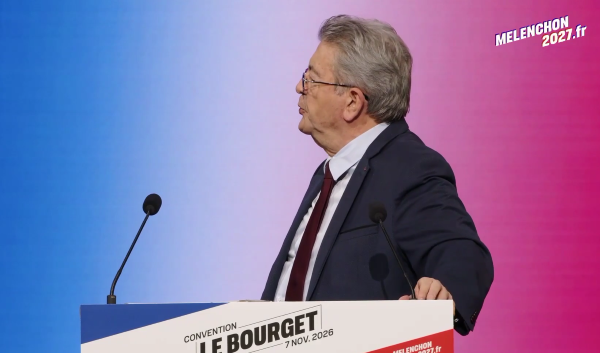
At his France Insoumise convention, Mélenchon, now 75 and campaigning for the fourth time for the presidency, addressed a crowd of 20,000 in a large venue north of Paris. He stated, “I have only one sensible thing to propose: Everything must change.” This veteran politician faces an urgent moment: three previous presidential campaigns ended before the runoff stage, and in 2022 he fell short by just 421,308 votes.
Currently surging in support, Mélenchon is now focused on a decisive confrontation with far-right frontrunner Marine Le Pen. His vision extends beyond merely winning the presidency; he seeks to redefine the foundational principles of the French republic, invoking the ideals of the Revolution of 1789.
Win or lose, his run could upend France
The upcoming 2 May runoff presents a challenging scenario. Should Le Pen emerge victorious, the anti-capitalist candidate, who has devoted over fifty years to opposing the far right, may inadvertently facilitate the far right’s first successful bid for the Élysée Palace, along with control over France’s nuclear arsenal. This outcome could have significant repercussions internationally, particularly given the current geopolitical climate with Donald Trump still in the White House and Russia engaged in military conflict in Ukraine.
Mélenchon has said he would withdraw France, the European Union’s only nuclear-armed power, from NATO, starting with its military command. Additionally, his proposed debt plans could position France at odds with Europe’s central bank, potentially unsettling financial markets. Critics argue that this poses a serious risk and accuse him of inciting unrest and antisemitism, as well as displaying a lack of respect for law enforcement and the media, and being overly accommodating towards Moscow. Mélenchon categorically denies these allegations.
Left’s Trump?
Born in Tangier, Morocco, in 1951, he began his political journey as a Trotskyist student before aligning with the Socialist Party for three decades, during which he rose to senator and junior minister. In 2008, he established his own political movement, characterised by what he has termed the “Mélenshow.”
At a recent campaign rally, sophisticated camera equipment documented the event while a film chronicled a woman’s life challenges. One by one, his associates presented various proposed solutions, transforming the rally into an assembly reminiscent of a government in waiting.
He also made pointed comments regarding former Socialist President François Hollande, who had filled the same venue during his ascent to power: “They only filled a third of the room,” he stated. To some observers, his rhetoric has drawn comparisons to that of Trump, who similarly boasts about crowd sizes and asserts, “I alone can fix it.” A prominent far-right mayor has referred to him as “the Donald Trump of the left.”
In 2018, during a search of his party’s offices by law enforcement, he expressed his defiance by declaring, “I am the Republic!” resulting in a conviction related to that incident. A 2025 investigative book portrays him as a leader who demands unwavering loyalty and regards dissent as treachery.
Focusing on poor suburbs
In 2027, he focuses on the youth and the suburbs. Le Bourget, in Seine-Saint-Denis, is the poorest department in mainland France. While the far right views it as a symbol of crime and failed immigration, Mélenchon sees it as the future: a diverse “New France” whose votes could propel him to power.
At the beginning of his party convention at Le Bourget, the hall fell silent to honour Pengo Bossio Wangi, a 26-year-old Frenchman of African descent, who was shot dead last month in a racist terror attack. Since September, protests over crumbling schools and teacher shortages have surged across France, leading to thousands of arrests. Mélenchon has supported the movement, declaring, “Don’t touch our young people.” Recently, cost-of-living protests escalated into looting in over 20 cities, including a fire at the City Hall in Limoges. Le Pen accused Mélenchon’s party of causing chaos, while Mélenchon blamed police tactics and denied organising the protests.
The traditional political order is crumbling, with the Socialists and Republicans capturing only 6.5% of the first-round presidential vote in 2022. A possible runoff between Le Pen and Mélenchon could sideline both traditional parties. Mélenchon is eager to harness this energy before rivals like former Prime Minister Édouard Philippe regroup, as a united centre could prevent a runoff between extremes.
Mélenchon’s populist programme
Mélenchon’s programme, which spans over 1,000 points, outlines a vision for a transformed country. Key proposals include lowering the voting age to 16, reinstating retirement at age 60, increasing taxation on the wealthy, and implementing a moratorium on artificial intelligence.
At the core of this initiative is a call for a new constitution to replace the Fifth Republic established by Charles de Gaulle in 1958. Mélenchon suggests forming a special assembly of citizens, composed exclusively of persons not currently serving as lawmakers, to draft this new constitution for approval by the electorate.
Additionally, he proposes that, between elections, citizens should be able to gather signatures to compel votes to repeal laws, amend the constitution, or even remove a sitting president.
Unbowed
Few French politicians elicit such profound devotion or anger. He has positioned Gaza as a pivotal issue for young people, asserting during a recent rally that “genocide must be called genocide.“ Activists, who allege that he fosters antisemitism—a claim he firmly denies—interrupted the event with whistles. He remarked, “Some commentators are advising me to tone things down. I won’t do that.”
He concluded by referencing a well-known gaffe made by President Emmanuel Macron in 2017, where Macron referred to “people who are nothing.“ The speaker adapted this into a line from the “Internationale,“ the historic anthem associated with communists and socialists worldwide. He proclaimed, “Macron told you that you are nothing. So let us be everything!“ The audience responded by singing “La Marseillaise.”
Ultimately, whether young people in No. 27 jerseys remember him as the leader who advanced his revolutionary agenda to the Élysée Palace or as one who inadvertently allowed the far right to gain traction may hinge on his steadfast refusal to moderate his approach.
This article used information from The Associated Press.
