
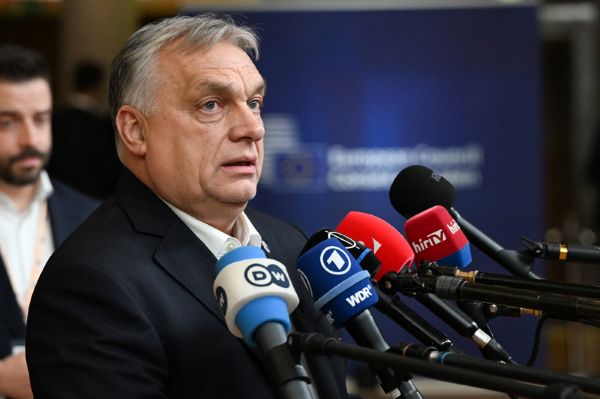
As the time of parliamentary elections in Hungary is close, Viktor Orbán seeks a lifeline in the energy crisis caused by the US-Israeli attack on Iran. These elections are critical because they will decide whether the authoritarian prime minister will survive or embark on an unknown and gloomy adventure.
On Monday, the Prime Minister of Hungary called upon the European Union to revisit and potentially suspend sanctions on Russian energy. He expressed concern that rising oil prices and supply disruptions could threaten regional energy security. The Prime Minister reported that he had sent a letter to European Commission President Ursula von der Leyen, urging a reconsideration of the sanctions imposed on Russian energy.
Alongside the far-right Prime Minister of Slovakia, Robert Fico, the Hungarian Prime Minister has chosen to maintain their energy dependence on Russia, expressing loyalty to Russian President Vladimir Putin. As a result, while other EU member states have initiated reductions in energy trade with Russia, Hungary and Slovakia face the potential risk of energy shortages.
Both nations have recently experienced disruptions in oil deliveries through the Druzhba pipeline, which transports Russian crude oil to Central Europe via Ukraine. This pipeline has suffered severe damage due to Russian military actions. Despite this, both leaders have refrained from acknowledging the source of the damage, instead placing blame on Ukraine for the delays in infrastructure repairs.
In a video message posted on X, he stated, “The Ukrainian oil blockade now represents the most serious threat not only to Hungary and Slovakia but also to the entire EU.” He indicated that the increase in fuel prices in Hungary is linked to what he called a “Ukrainian oil blockade,” alongside escalating tensions in the Middle East. He underscored the necessity for the Hungarian government to act to prevent gasoline and diesel prices from reaching “unbearable levels.”
The Hungarian parliamentary elections are scheduled for 12 April. This time Orbán’s regime is seriously challenged by the opposition party Tisza. Orbán, who serves the Russian interests within the EU, is backed by President Putin. At the same time, he also enjoys the support of US President Donald Trump and the MAGA political movement. Although Orbán’s party, Fidesz, comes second behind Tisza in the polls, the opposition’s victory and the end of the regime are not yet secured. A potential electoral defeat of Orbán could have considerable impacts not only for the Hungarian political landscape but also for the governments of Fico in Slovakia and Andrej Babiš, the far-right Prime Minister of the Czech Republic.
