
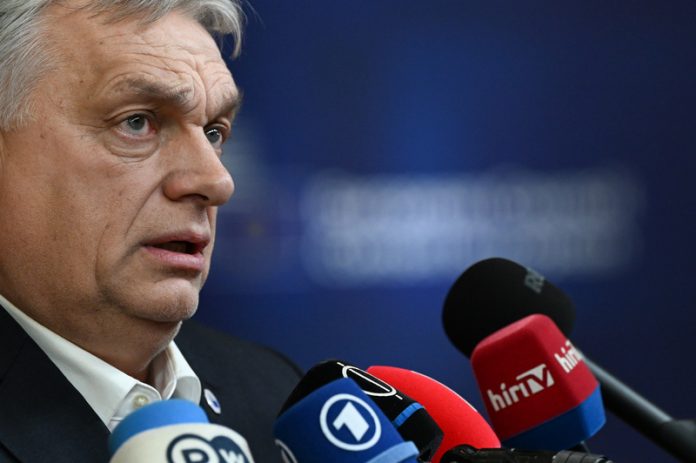
As Hungary approaches a challenging election, Prime Minister Viktor Orbán, who maintains a pro-Russian stance, is endeavouring to sway voters by framing the primary threat to the nation as neighbouring Ukraine, rather than the economic stagnation emphasised by his leading opponent.
Orbán is executing a vigorous media campaign characterised by controversial messaging. He contends that Hungarians should resist aligning with the broader European stance of supporting Ukraine amidst Russia’s invasion, positing that such alignment could jeopardise the country’s economic stability and endanger the lives of its youth on the battlefield.
A notable aspect of this campaign is the installation of billboards across the country featuring AI-generated images of Ukrainian President Volodymyr Zelenskyy alongside European officials. These visuals depict Zelenskyy extending his hand, suggesting a request for financial assistance. This imagery serves as a pointed reference to the European Union’s ongoing efforts to provide financial aid and strengthen Ukraine’s defences as the conflict enters its fifth year.
“Our message to Brussels: We won’t pay!” the publicly funded billboards read.
On Monday, it became clear how Hungary’s upcoming election could have a broader impact. Hungary blocked a new EU sanctions package against Russia due to disruptions in Russian oil supplies via Ukraine and pledged to veto pro-Ukraine policies until oil flows resume.
PM Orbán is seen as the Kremlin’s strongest ally in the EU, having deepened cooperation with Russia as most other EU nations have distanced themselves since the war started on 24 February 2022. Additionally, Orbán’s anti-LGBTQ+ policies and crackdowns on media and NGOs have drawn accusations that he mimics Vladimir Putin‘s authoritarian tactics.
Campaign of fear
Orbán, who returned to power in 2010, faces a significant challenge in the 12 April election. The longest-serving leader in the EU, he and his far-right Fidesz party, an ally of Marine Le Pen, are trailing in polls against centre-right challenger Péter Magyar. A 44-year-old lawyer and former Fidesz insider who left the party in 2024, Magyar focuses his campaign on rising living costs, improving social services, and fighting corruption. He aims to restore Hungary’s alignment with Western values and strengthen democratic institutions.
Magyar’s rise is supported by scandals that have damaged Fidesz’s credibility, notably a presidential pardon for a child abuse case that led to public outrage and resignations of top officials. In response, Orbán and Fidesz have launched a campaign with taxpayer-funded advertisements claiming the EU’s financial support for Ukraine would harm the economy. They depict Magyar as a pawn of Zelenskyy and the EU, accusing him of selling Hungary to foreign interests. Hungary’s public and many private media outlets, loyal to Orbán’s government, amplify these messages, suggesting Ukraine is prolonging the conflict for its own gain.
Orbán himself, panicked by the prospect of losing the upcoming elections, spread disinformation through his personal X account.
“Last week in Munich, the leader of the opposition Tisza Party, under German patronage, concluded a secret pact with Brusselian leaders. In exchange for the support of Brussels and Kyiv, he would pull Hungary into the group of European countries at war, agree to further financial support for Ukraine, and cut Hungary off from affordable oil and gas,” he posted on X on Wednesday.
Artificial intelligence at the service of disinformation
Orbán recently claimed that the European Union, rather than Russia, is the greatest threat to Hungary. He contends that rising defence spending in Europe, spurred by Russia’s war and US pressure to increase NATO contributions, suggests the EU is preparing for conflict with Moscow and may force Hungarians into military service.
In an AI-generated video by Fidesz, a little girl asks her mother when her father will come home. In the next scene, the father, blindfolded and bound on a battlefield, is shot by a soldier. The narrator states, “We won’t allow others to decide the fates of our families. Let’s not take a risk. Fidesz is the safe choice.”
While some EU countries have proposed sending troops to Ukraine to monitor a potential ceasefire, such participation would be voluntary and not intended for combat, according to András Rácz from the German Council on Foreign Relations. He notes that despite the misleading nature of Orbán’s claims, Fidesz has previously won elections by instilling fears of war.
“They are trying to max this out. They have nothing else,” Rácz said. “Populists often try to define an enemy, often an imaginary one, and then offer protection to the society from that enemy. Ukraine has been ideal from this perspective.”
Escalating tensions
For several years, Prime Minister Orbán has sought to deter European Union initiatives to provide financial and military assistance to Ukraine. He has consistently opposed sanctions directed at Russian oil and officials. Recently, tensions with Ukraine have escalated following the interruption of Russian oil shipments to Hungary; Ukraine attributed this disruption to a Russian drone strike in late January that damaged a pipeline, while Orbán characterised the situation as an act of blackmail. In response to these developments, last week the Hungarian government suspended diesel shipments to Ukraine and threatened to veto a €90 billion EU loan intended for Kyiv. Moreover, on Monday, Hungary blocked the 20th round of EU sanctions against Russia.
“Yesterday, the Brusselian leaders, with @vonderleyen at the forefront, reached an agreement with President @ZelenskyyUa to continue the war. This is bad news for Europe. A war is being prolonged that clearly has no solution on the battlefield, yet causes immense destruction,” Orbán posted on X on Wednesday.
“Continuing the war costs European citizens enormous sums of money. Hundreds of billions of euros are being squandered with no result. In this war, it is not the Russians who are being crushed, but Europeans. On top of this, the risk of nuclear escalation remains, as Europe is confronting a nuclear power,” added the pro-Kremlin prime minister.
The anti-Ukraine campaign has gained support among Fidesz loyalists, but many Hungarians remain sceptical of Orbán’s messaging. On Sunday, hundreds of Hungarians and Ukrainians, including refugees, gathered in central Budapest to mark the fourth anniversary of Russia’s invasion. They marched toward the Russian embassy, holding flags and chanting, “Stop Putin, stop the war!”
Budapest’s liberal mayor, Gergely Karácsony, told The Associated Press that Orbán’s messaging and policies are “a betrayal not only of Ukraine, but of Hungary’s national interest.”
“I hope that this will go into history as a failed policy, but that history will also remember that there were some who stood up for what is right,“ he said.
This article used information from The Associated Press.
