
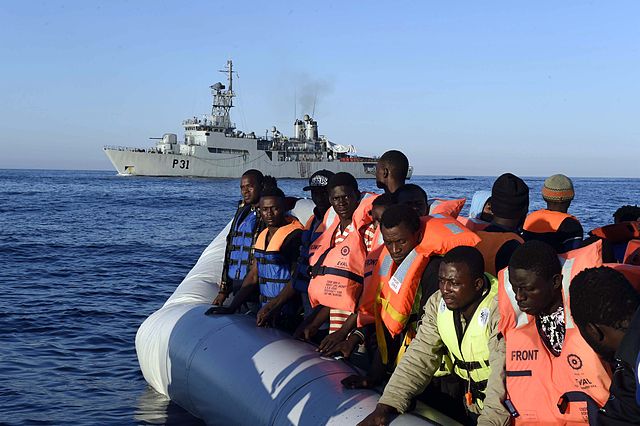
Migrants attempting to reach Europe are disappearing in droves, casualties of so-called “invisible shipwrecks”, yet the governments responsible for carrying out search and rescue operations continue to withhold information about what they know.
To date, 2026 marks the deadliest start to any year for people trying to cross the Mediterranean. An unprecedented 682 migrants have been confirmed missing as of 16 March, according to IOM, the UN’s International Organisation for Migration. Almost certainly, the actual death toll is far higher, with bodies washing ashore daily, relatives’ phone calls going unanswered and growing evidence of abandoned migrant tents.
Human rights groups seeking to verify the toll find themselves up against a near wall of silence as countries such as Italy, Tunisia and Malta clamp down on details about migrant rescues and shipwrecks along what has become the most hazardous migration route in the world.
“It’s a strategy of silence,” said Matteo Villa, a researcher specialising in migration data at the Italian Institute for International Political Studies think tank.
Once monthly, then quarterly, the Italian coast guard stopped providing detailed data on migrants rescued in 2020. Two years later, it removed all previous reports from its website. This year, the coast guard did not share any migration-related press releases despite nearly 5,000 migrants disembarking on Italian shores, according to the country’s Interior Ministry statistics.
Refugees in Libya and other international human rights groups have been sounding the alarm since late January, reporting more than 1,000 people missing after Cyclone Harry hit the region. To date, authorities have neither confirmed, denied nor corrected those reports.
In the weeks that followed the cyclone, more than 20 decomposing bodies were washed ashore along the coasts of Italy and Libya, while bodies were also spotted floating in the middle of the sea.
The only known survivor from boats reported missing during Cyclone Harry told crew members of the merchant vessel that rescued him that he had been travelling with another 50 people. Because of his testimony, these deaths were included in IOM’s tally.
According to the rescue vessel’s captain, the sole survivor was evacuated to Malta. The Maltese Armed Forces did not respond when queried about their involvement.
Not knowing the fate of their loved ones has become a recurring nightmare for families of missing migrants.
“Europe should know that these people who got drowned in the sea have family members, have dreams, have passions,” Josephus Thomas, a migrant from Sierra Leone and a community leader in Tunisia’s coastal town of El Amra, told the Associated Press.
Stymied by the lack of information, the UN’s migration agency finds itself more and more frustrated in its efforts to verify cases of migrants dying in what are known as “invisible shipwrecks”.
Last year, according to Julia Black, head of IOM’s Missing Migrants Project, at least 1,500 people were reported missing whose fates the agency was unable to confirm. The issue persists in 2026.
“We started a new secondary data set of what we are calling unverifiable cases because it’s just become so many,” Black said. So far this year, they are already dealing with more than 400 missing persons whose fates they cannot verify.
Many humanitarian organisations are no longer able to fill some of the information gaps, the result of funding cuts and government-imposed restrictions across the region.
Authorities in the Mediterranean have reduced information related to migrants over recent years, a silence that became even more pronounced in late January following Cyclone Harry, which unleashed heavy rainfall, winds of 100 kph, and nine-metre-tall waves.
Hundreds of people that left from Tunisia’s coastal region of Sfax have disappeared, according to information the Refugees in Libya group gathered from migrants in Tunisia and their relatives abroad. “We are looking at boats that never counted how many kids are inside,” Refugees in Libya founder David Yambio told AP.
When the news agency sought information from the Italian coast guard about boats reported missing and related search efforts there was no response. An officer answering the phone said the Coast Guard did not have “any further verified and confirmed information regarding the circumstances.”
The coast guard also declined to comment on an alert it issued on 24 January requesting vessels sailing between the Italian island of Lampedusa and Tunisia to be on the lookout for eight small boats in distress carrying some 380 people.
The Tunisian Foreign Ministry and the Tunisian National Guard also have not responded to multiple requests for information.
Frontex, the European Union agency charged with assisting nations with border surveillance, told AP that it had spotted eight boats carrying about 160 migrants in the period between 14 and 24 January when Cyclone Harry hit. Six of the boats were rescued by Italian authorities, but the fate of the other two remains unknown.
In June 2024, Tunisia’s Ministry of Interior stopped releasing any information on migrants, citing security concerns, according to Romdhane Ben Amor, spokesperson for the Tunisian Forum for Economic and Social Rights (French acronym FTDES). He believes the motives were political; that the numbers were incompatible with the narrative that Tunisia was not Europe’s border guard.
