
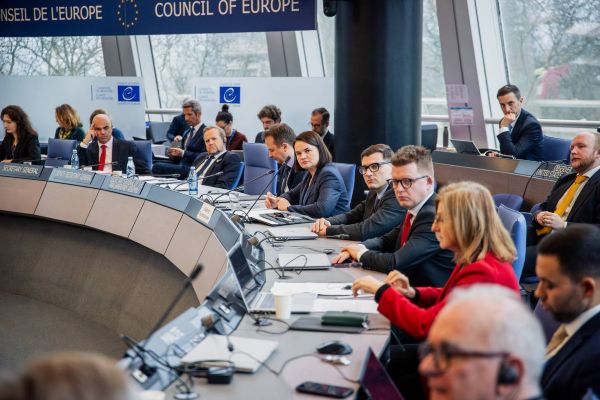
At a meeting in Strasbourg, Alain Berset, Secretary General of the Council of Europe (CoE), reaffirmed the organisation’s commitment to supporting the aspirations for a free and democratic Belarus. Sviatlana Tsikhanouskaya, the leader of the Belarusian democratic forces, addressed the Committee of Ministers on 25 February.
In response to the current situation, the Council of Europe established a Contact Group in late 2022 to foster cooperation with Belarusian democratic forces and civil society. This initiative followed the suspension of all cooperation with the Belarusian authorities in March 2022. The Contact Group represents an innovative approach to continuing to engage with Belarusians in exile, particularly democratic activists, young people, independent journalists, and human rights defenders, within a complex and evolving international context.
“The Contact Group’s vision is as simple as it is ambitious. When democratic change happens, democratic forces and civil society must be prepared and capable to the greatest extent possible to implement Council of Europe standards of democracy, rule of law and human rights, and anchor Belarus in the European family of democracies,” the Secretary General said.
“The Council of Europe is determined to support the work of the Contact Group with both political commitment and technical expertise. As a pioneering framework, the Contact Group contributes to the broader Council of Europe agenda of promoting our shared values, and in particular to the New Democratic Pact for Europe,” Alain Berset stressed.
The Council of Europe and Belarusian partners have made significant strides since the establishment of the Contact Group. Between 2024 and 2025, several key projects were implemented, including a placement programme for Belarusian professionals. The Council’s efforts aided democratic forces in drafting the Memorandum on the abolition of the death penalty and the Statement of Principles on Non-Discrimination.
A strategic dialogue began in early 2025 between young Belarusians and decision-makers from the Parliamentary Assembly of the Council of Europe (PACE) and the Congress of Local and Regional Authorities, ensuring representation of Belarusian democratic forces. In 2024, PACE released “The Luxembourg Solutions,” offering recommendations to support Belarusians in exile, including access to education and preservation of cultural identity.
The Congress has contributed expertise on local self-government reform and addressed transnational repression against exiled Belarusians, emphasising localised initiatives from “The Luxembourg Solutions.” Plans for 2026-2027 will focus on promoting human rights, abolishing the death penalty, combating discrimination, advancing gender equality, and supporting civil society and journalists in exile. The placement programme will continue, and an Information Point for Belarusians will be launched in Vilnius to enhance on-ground activities.
