
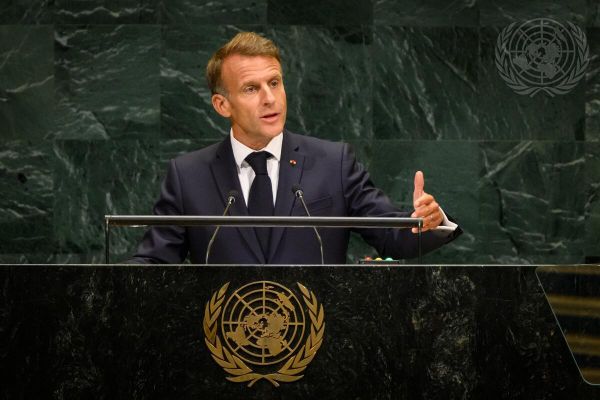
French President Emmanuel Macron highlighted a significant choice facing the global community during his address on Tuesday: “Do we want to live… with a return to the law of the jungle, or do we want to live in a civilised international society?”
Addressing the General Assembly, he reaffirmed France’s commitment to the United Nations and the revitalisation of multilateralism to address shared challenges collectively. He urged against succumbing to defeatism, declaring, “We will not yield to defeatism”, while highlighting various ongoing crises and conflicts.
President Macron emphasised that international law not only reflects reality but also sets the parameters of acceptable behaviour. He expressed concern that the lessons of the 20th century have been overlooked, as evidenced by the current prevalence of “industrialised” war crimes and a resurgence of barbarism.
He lamented the erosion of the Geneva Convention, referencing humanitarian crises in regions such as El Fasher in Sudan and the devastation in Gaza. He firmly stated, “There cannot be peace without justice,” reiterating France’s steadfast support for the International Court of Justice (ICJ).
He asserted that “we simply cannot accept this new order of impunity that some are attempting to create.” In line with this, President Macron expressed support for reforming the UN Security Council to enhance its effectiveness, including adding new members, particularly from Africa, to empower it to respond to mass violations of international law.
A substantial part of his address focused on the need to bridge divides between the Global North and South, which he said is essential to effectively addressing issues related to climate change, health, and development. He acknowledged that achieving this goal would require reopening a dialogue concerning shared history, cultural relationships, and the principles of restorative justice.
Against “double standards” regarding sovereignty
The French President strongly condemned the “double standards” surrounding sovereignty, asking, “How many times have we heard that the sovereignty of people is important in Europe, yet when it comes to the Middle East and Africa, it appears to be disregarded?”
He emphasised that when certain states overlook the will of specific peoples—attempting to change systems or topple regimes—it often results in greater chaos.
The President reaffirmed his support for Ukraine amid the ongoing Russian invasion and highlighted the importance of restoring freedom of navigation in the Hormuz Strait.
Furthermore, he expressed his solidarity with the Palestinian people in both Gaza and the West Bank. He pointed out that while some claim peace has been established in Gaza, humanitarian corridors have yet to be realised, a statement that was met with applause.
AI independence
The concluding section of the speech addressed the significant risks associated with artificial intelligence, highlighting the concern that most individuals and countries lack a voice in the AI regulation discourse.
He emphasised that this matter should not be relegated solely to the United States, China, and a limited number of private stakeholders. The potential consequences are far too severe, given this technology’s capacity to jeopardise “the security of our states, hospitals, and financial institutions.”
In his closing remarks, President Macron acknowledged Europe’s progress in establishing legal frameworks for artificial intelligence, as well as the efforts of various countries to restrict access to technologies that negatively affect the learning capabilities of children and adolescents. He advocated developing more comprehensive regulatory frameworks to safeguard young people in the context of technology, saying, “Let’s not wait for the consequences to come raining down.”
