
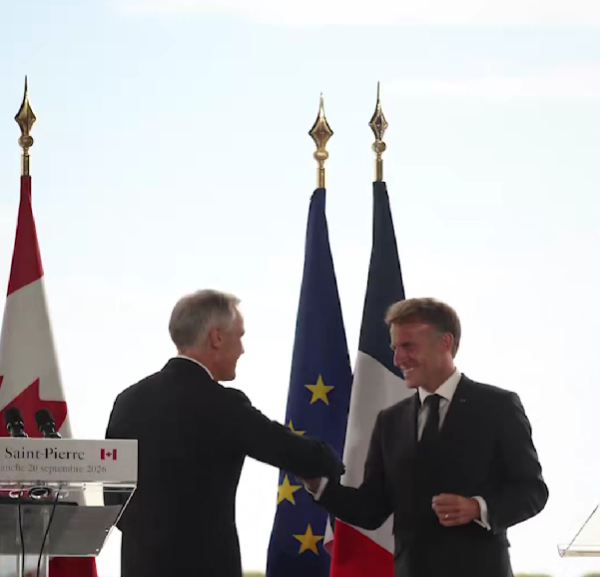
French President Emmanuel Macron has publicly supported the European Commission President Ursula von der Leyen‘s proposal for Canada to become the European Union’s first associate member in a meeting with Canadian Prime Minister Mark Carney. This initiative aims to strengthen strategic ties between Canada and the EU across several critical areas, including space, defence, energy, and business.
The meeting took place in Saint-Pierre-et-Miquelon, a French territory located near Newfoundland, illustrating the geographic proximity between Canada and France. This context underscores Canada’s increasing orientation towards Europe at a time when relations with the United States are becoming more complex.
President Macron emphasised, “We fully support the agenda for closer ties with the European Union, both as an associate member and as a full member of the European community.” Canadian Prime Minister Mark Carney added, “Only a few kilometres separate Canada and France at their closest point, and our shared values are even more closely aligned.”
Prime Minister Carney also announced that the two countries will instruct their respective space agencies and defence ministries to collaborate to enhance and share infrastructure, including launch systems and ground-based reception facilities.
Additionally, both leaders expressed their commitment to expanding cooperation in energy, telecommunications, climate resilience, and economic development.
Carney believes that closer ties with Europe would reduce Canada’s vulnerability to economic pressure from any single country, especially in light of Trump’s tariffs and comments about making Canada the 51st US state. Recently, Trump shared a map on social media showing the US flag over all of North America, including Canada and Saint-Pierre-et-Miquelon. France’s interest in Canadian resources
President Macron recently emphasised that Sunday’s discussions are part of broader efforts to ensure France’s access to oil and gas supplies. The ongoing conflict in Iran is disrupting global energy markets and raising concerns about rising prices for fuel and essential goods.
Macron remarked, “Canada possesses significant resources in critical minerals and rare earth elements, as well as being a major producer of oil and natural gas. Our objective is to finalise agreements that will facilitate the import of additional liquefied natural gas to Europe’s Atlantic coast.”
The leaders discussed a range of topics, including aerospace, energy, critical minerals, and advanced technologies such as quantum computing, satellites, and supercomputing, according to a statement from Carney’s office.
Later Sunday, Carney returned to Ottawa to meet with Norwegian Prime Minister Jonas Gahr Støre for strategic talks on defence, Arctic security, energy, critical minerals, and emerging technologies, ahead of his participation in the U.N. General Assembly in New York on Monday.
During a joint press conference with Støre, Carney addressed the idea that strengthening Canada’s ties with European allies might be perceived as antagonistic towards the United States. He said Canada is a more effective partner when it maintains its independence and resilience while fostering strong relationships globally.
Additionally, Sunday’s meeting followed President Donald Trump‘s announcement regarding a deal related to Greenland, which aims to expand the US military presence on the island while preserving Danish sovereignty. Macron welcomed this agreement, asserting, “Danish sovereignty is being respected; international law is being upheld. Any initiative that contributes to easing tensions is commendable.”
This article used information from The Associated Press.
