
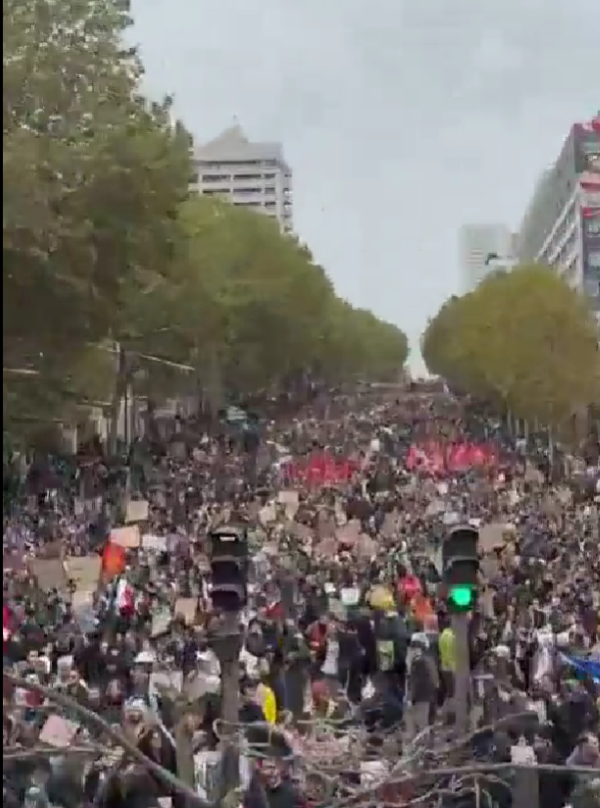
Clashes erupted in Paris as a major march concluded on Saturday, with more than 400,000 people rallying across France to voice concerns about school funding and rising living costs. This protest represents a new challenge to President Emmanuel Macron‘s administration. According to government reports, authorities made nearly 1,000 arrests during the events.
The march in Paris began peacefully, following a week of widespread rioting and looting tied to earlier protests. However, as the demonstration approached its conclusion in eastern Paris, some masked persons began to launch objects and fireworks at law enforcement officials. In response, the police deployed tear gas, sound grenades, and water cannons to manage the situation. Officers used megaphones to instruct the crowd to disperse; however, panic ensued among some protesters as tear gas canisters were released, prompting them to scatter amid raised alarm. Experienced protesters cautioned others, urging them not to flee.
The Interior Ministry estimated the nationwide turnout at 410,000, down from the 550,000 reported during protests the previous weekend. Conversely, the CGT union, which helped organise Saturday’s events, estimated turnout at nearly 800,000. The ministry’s figures included 110,000 participants in Paris, where the march was confined to the city’s southeastern area, away from the central district. The CGT claimed about 250,000 protesters in Paris.
A month of unrest
After over a month of unrest that began with high school protests calling for increased funding and teacher support, President Macron’s authority faces significant challenges in the final months of his presidency, ahead of the upcoming succession elections in May.
The situation is critical, as the far-right National Rally party has criticised the government for perceived failures in public safety and urged citizens to channel their frustration into supporting their candidate, Marine Le Pen. Conversely, on the populist left, presidential candidate Jean-Luc Mélenchon has voiced his support for the demonstrators, while also condemning police actions that have resulted in serious injuries among some youthful protesters.
On a recent Saturday evening, violence broke out following some of the 289 protests reported by the Interior Ministry across France. It included street fires in cities such as Marseille and Lyon. The police utilised tear gas in several cities, including Lyon, Clermont-Ferrand, Strasbourg, and Bordeaux, and employed water cannons in Nice and Nantes. In Nice, clashes occurred between far-right extremists and demonstrators in the downtown area, leading to 11 arrests according to regional authorities.
Interior Minister Laurent Nuñez reported nearly 1,000 arrests; however, he expects the number to rise as authorities account for additional incidents. He highlighted that the enhanced police presence, comprising 70,000 officers supported by helicopters, armoured vehicles, and other resources, played a crucial role in preventing further looting and destruction of property, which had marred the previous weekend’s events.
A small protest became a national movement
What began as a protest over staff shortages at a high school southeast of Paris has expanded nationwide. Students are demanding more funding for education, and workers are seeking help with rising costs. In Paris, teacher Bénédicte Pittion marched with her 16-year-old daughter, Garance, in their first protest together. “The young people demonstrating have not been heard, and I stand with them,” said Pittion. Garance felt “really scared” after the previous weekend’s violence but believed that not participating would favour the government.
Soumaya Abed, a 58-year-old nurse in a red CGT union vest, criticised Paris authorities for forcing protesters to march on the city’s outskirts, far from central attractions like the Louvre. “But it won’t stop the movement or students from demanding better school conditions,” she said. Protesters voiced anger over rising poverty and wealth inequality under President Macron.
In Marseille, police estimated 17,000 attendees, while the CGT union claimed 100,000. Additionally, Toulouse saw 26,500 participants. Authorities banned rallies in cities like Lyon, Nice, and Montpellier, which trade unions condemned as violations of constitutional rights. Separately, thousands marched peacefully in Orléans against the far right while Le Pen’s National Rally held a congress.
Gendarmes were stationed beneath the Arc de Triomphe on Saturday, as shopkeepers boarded up storefronts across Paris. Near the Saint-Lazare train station, contractor Akram Ahmed was securing an optician’s shop. “The owner sounded desperate. He said I was saving his life,” he explained. Art Basel, a major contemporary art fair, opened to the public on Friday but cancelled its weekend programme due to unrest concerns.
Student groups are calling for an additional 250,000 places in higher education and the removal of selection through the Parcoursup admissions system. Their ten-point plan calls for more teachers, repairs to schools and universities, and increased financial support, including an extra €200 per month in student grants and a rent freeze in public housing. In September, energy prices in France rose 21.3% from last year, pushing overall inflation to 3.1%, according to INSEE.
This article used information from The Associated Press.
