
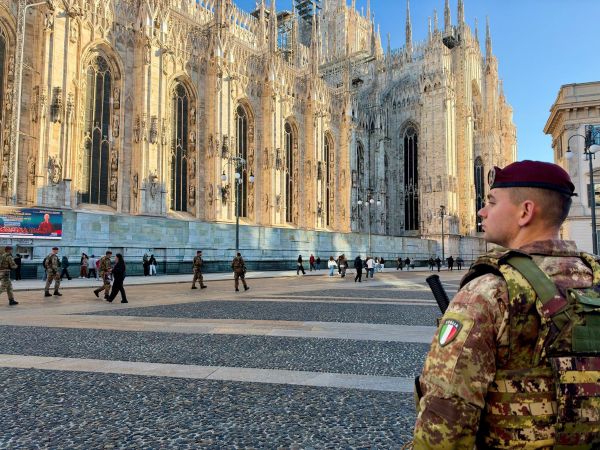
Thousands of young people marched through the streets of Milan on Saturday, with a large number of soldiers present and luxury boutiques boarded up in anticipation of a possible recurrence of last weekend’s unrest, which led to looting and confrontations. Prime Minister Giorgia Meloni announced a comprehensive set of measures, including the deployment of an additional 500 soldiers to Milan and the implementation of stricter penalties for minors, who, according to police reports, constituted a considerable part of the violent protesters during the previous week.
While protests in France drew most international attention, large demonstrations also took place in several other European cities on Saturday, including Madrid, Lisbon, and Tirana. These protests reflect a wide range of concerns, including education, corruption, anti-war sentiment, pensions, and housing.
In Milan, large crowds of young protesters gathered at night, chanting insults against Prime Minister Giorgia Meloni and holding banners like “No to lies of the state.” Some demonstrators dumped manure outside the energy regulator’s office and burned a symbolic electricity bill, as local news broadcasts showed. Authorities deployed 500 soldiers to support about 5,000 police and security personnel, with enhanced security measures including drone surveillance and checks at railway stations.
Many luxury boutiques, such as Omega and Gucci, boarded up their windows following previous riots that targeted stores near the Duomo square. Protests also took place in Rome and Turin, with some incidents turning violent. Authorities are investigating a 30-year-old freelance journalist reported to be the “mastermind” of the recent 17 October movement, which has driven the protests.
Milan police indicated that last week’s violence involved approximately 2,000 young protesters, including many second-generation Italians. Over two days, 45 people were arrested, including 34 minors. Milan’s welfare councillor highlighted growing social and economic inequalities that contribute to youth exclusion. Defence Minister Guido Crosetto noted that soldiers are authorised only to use plastic restraint ties around train stations and are not allowed to carry pepper spray or tasers.
Protest also in Rome
Security measures in Rome were intensified, with authorities locking down luxury shopping streets and increasing controls around the Circus Maximus and Piazza del Popolo. A small group of protesters tried to enter the Colosseum, but guards quickly removed them. Meanwhile, several hundred students held a peaceful demonstration, emphasising that they do not support rioters. Organisers also held an anti-war march, urging participants to keep their faces uncovered and hands visible to prevent unrest.
This article used information from The Associated Press.
