
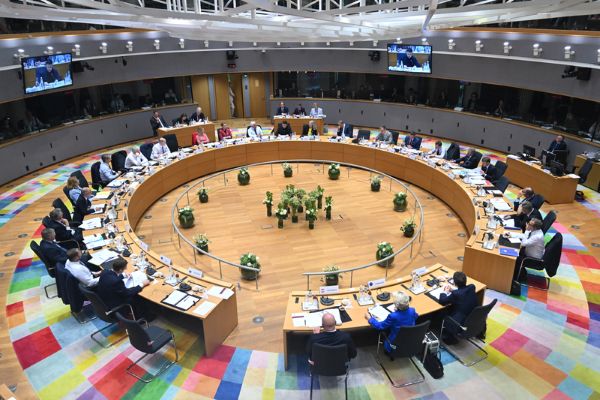
The European Union has reached an agreement on a new series of sanctions against Russia, focusing on its shadow fleet of oil tankers and imposing a ban on imports of liquefied natural gas. The Danish EU presidency made this announcement on Thursday.
Danish Foreign Minister Lars Løkke Rasmussen expressed optimism, stating, “Today is a good day for Europe and Ukraine,” as EU leaders convened for a summit in Brussels. He highlighted that the newly introduced sanctions will implement comprehensive measures across oil, gas, and the shadow fleet. The new measures specifically target crypto-related payment services and expand the prohibition on the provision of certain software. This encompasses software utilised in banking, finance, commercial space-based services, technical testing and analysis, as well as artificial intelligence and quantum computing. The measures also target the services sector and strengthen anti-circumvention tools. Additionally, the Council decided to establish a new protocol to restrict the movement of Russian diplomats within the 27-nation EU.
This development follows the recent imposition of sanctions by the Donald Trump administration in the United States against Russia’s oil industry, aimed at prompting Russian President Vladimir Putin to engage in negotiations and work towards concluding the conflict in Ukraine. Energy revenue plays a vital role in Russia’s economy, enabling the government to fund military operations while maintaining economic stability for its citizens.
The process of reaching consensus on the new EU measures took nearly a month. The EU has already enacted 18 packages of sanctions in response to the war, with final agreements on specific targets often requiring extensive discussions. The sanctions agreement was finalised during a meeting of EU ambassadors on Thursday morning, shortly before Ukrainian President Volodymyr Zelenskyy addressed the summit with his European counterparts to advocate for a ceasefire after nearly 4 years of conflict.
The current package introduced five new listings concerning the Belarusian military-industrial complex and the Lukashenka regime. Additionally, it reflects Belarus’ trade measures in alignment with those imposed on Russia.
“We have just adopted our 19th package of sanctions. It targets Russian energy, banks, crypto exchanges, and entities in China, among others. The EU is also regulating the movements of Russian diplomats to counter attempts at destabilisation. It is becoming increasingly difficult for Putin to finance his war. Every euro we deny Russia is one it cannot spend on war. The 19th package will not be the last,” stated Kaja Kallas, High Representative for Foreign Affairs and Security Policy/Vice-President of the European Commission.
This summit also follows President Trump’s announcement that plans for a swift meeting with President Putin are currently on hold, as he seeks to avoid what he perceives as a futile exercise. This adds another layer of complexity to ongoing efforts to resolve the conflict. Additionally, the leaders are eager to advance discussions on Trump’s Gaza peace plan and will explore ways to ensure continued European involvement in the negotiations.
The Associated Press noted that, although the European Union is the largest provider of humanitarian aid to the Palestinian territories, it has faced challenges in exerting influence over Israel, partially due to differing perspectives among member states regarding the conflict. In contrast, the EU’s involvement in the war in Ukraine is more clearly defined, particularly as Russian armed forces intensify attacks on Ukraine’s energy infrastructure during the onset of colder weather.
Earlier this week, Ukraine’s principal European supporters, part of a coalition of over 30 countries, expressed opposition to any proposals suggesting that Ukraine should cede territories captured by Russian forces in exchange for peace, as indicated by President Trump. The United Kingdom is scheduled to host a meeting of coalition members on Friday.
Furthermore, EU leaders are expected to endorse plans to utilise a portion of the billions of dollars in frozen Russian assets to support Ukraine’s defence efforts, despite reservations about the potential repercussions. The largest segment of these frozen assets, estimated at $225 billion, is held in Belgium, where the government has shown caution in proceeding without firm assurances from its European partners. Ukraine’s projected budget and military needs for 2026 and 2027 are estimated at approximately $153 billion.
Finally, EU leaders are likely to approve a new strategic framework aimed at enhancing Europe’s capacity to defend itself against potential Russian aggression by the end of the decade, as officials anticipate that Russia may seek to target another European nation within the next 3 to 5 years.
