
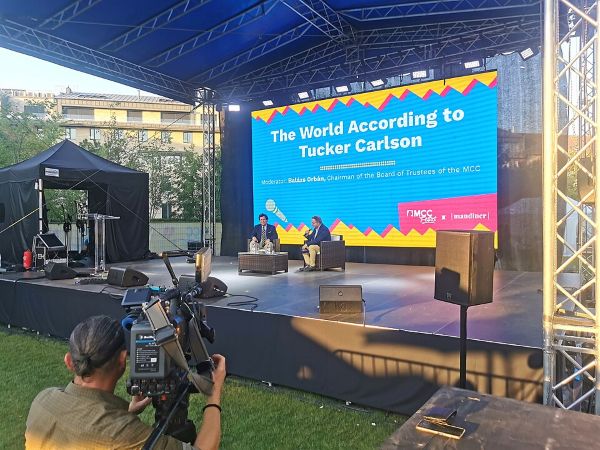
On 14 April, Péter Magyar, the leader of the Tisza party and Hungary’s next Prime Minister, announced that his government will terminate funding for the far-right CPAC Hungary event and for the Mathias Corvinus College (MCC), according to reports from G4Media and Radio Târgu Mureș. Magyar said that such funding by Viktor Orbán‘s administration might violate legal stipulations, as the law prohibits the mingling of party funding with public expenditure. The institution has a significant presence in Romania, where it disseminates Orbán’s propaganda within the Hungarian community.
Additionally, Zalán Alkonyi, a researcher, historian, and analyst of international relations at MCC in Budapest, disclosed that he experienced significant pressure to produce promotional articles in support of Prime Minister Viktor Orbán’s Fidesz party during the final months of the electoral campaign.
Furthermore, an investigation conducted by the Hungarian portal HVG has revealed tangible connections between Moscow’s influence networks and foreign experts engaged by the MCC.
Mathias Corvinus College operations in Romania
G4Media reports that Mathias Corvinus College (MCC) has become a key instrument of Budapest’s “cultural diplomacy” in Romania, receiving substantial funding from Hungarian state resources and companies like MOL and Gedeon Richter. Operating through the Mathias Corvinus Collegium Foundation in Cluj-Napoca, MCC has expanded into cities with sizable Hungarian communities, including Târgu Mureș and Sfântu Gheorghe. Its mission is to provide extracurricular programmes in leadership, economics, and international relations for talented students.
Critics argue that MCC aims to cultivate a new intellectual elite in Transylvania loyal to Fidesz ideology, promoting sovereignism and criticism of the European Union. A 2025 investigation by Edupedu.ro indicated that MCC’s activities do not align with Romania’s national education system.
Additionally, the foundation has acquired significant properties, including the historic Melody Hotel in Cluj-Napoca, which serves as an educational centre. It also hosts large events featuring international speakers, aiming to integrate young Hungarian students into an ideologically controlled information ecosystem.
