
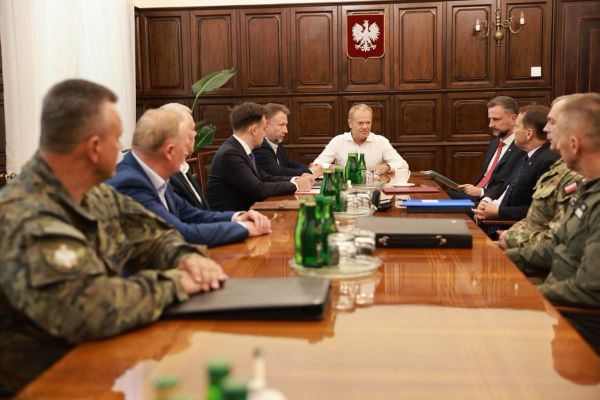
Poland has committed to enhancing security measures along its border with Ukraine, following a series of Russian drone strikes that occurred near the frontier, some of which came within kilometres of Polish territory. This decision follows warnings from Polish Prime Minister Donald Tusk, who indicated that Moscow appears poised to escalate its military campaign against Ukraine’s borders with European countries.
Ukraine is currently facing significant pressure from Russia’s intensified air campaign, which utilises ballistic missiles and jet-powered drones to breach defences.
Prime Minister Tusk remarked, “In the coming weeks and months, we can expect a substantial increase in Russian military actions. Regrettably, we cannot dismiss the possibility that this escalation may impact our own territory.” He had previously issued a similar alert last Thursday.
Defence Minister Władysław Kosiniak-Kamysz confirmed on Monday via a post on X that the Polish army had recovered a military drone, believed to be of Russian origin, from the Baltic Sea near the coastal village of Jaroslawiec. Polish officials have suggested that intelligence reports, including a briefing from the CIA last week, indicate Russia may target border points and engage in intensified sabotage operations within European countries as part of an effort to dissuade support for Ukraine.
In light of these developments, Prime Minister Tusk has expressed intentions to engage with NATO allies to prepare for a potential coordinated response. Polish Foreign Minister Radosław Sikorski emphasised the alliance’s military capabilities, saying that, in the event of Russian aggression against NATO, European air forces—independent of US involvement—could effectively neutralise a significant portion of Russia’s oil refineries.
Deputy Defence Minister Cezary Tomczyk characterised the drone strikes on Sunday as a troubling escalation by Russia. He remarked on broadcaster TVN24 that any resulting spillover into European territories could take the form of sabotage or a severe escalation of hybrid warfare, or manifest in other actions along NATO’s borders.
These warnings follow a strike on a train near the Ukraine-Poland border on 13 September, which occurred minutes after a diplomatic delegation, including former British Prime Minister Boris Johnson and former Swedish Prime Minister Carl Bildt, passed through the same station, according to Ukraine’s state rail operator. A second strike targeted a different border crossing point between Poland and Ukraine.
Kaja Kallas, the European Union’s chief diplomat, expressed on Monday that the drone attacks near Poland’s border were clearly intended to intimidate Western countries from continuing their support for Ukraine. She stated, “We must demonstrate our solidarity with Ukraine and maintain our resolve.”
NATO Secretary-General Mark Rutte said the Russian strike on the train would prompt the alliance to strengthen its support for Kyiv and fortify defences along its extensive eastern border with Russia. He affirmed, “President Putin seems to believe he can deter us from supporting Ukraine and undermine our unity. He is mistaken.”
Kremlin spokesman Dmitry Peskov, when asked about the strike on a train near the Polish border, stated that Russian forces are operating throughout Ukraine and will continue to do so. He highlighted the role of Global South nations in encouraging the Kyiv regime to be more flexible in negotiations.
Peskov noted that both Chinese President Xi Jinping and Indian Prime Minister Narendra Modi expressed willingness to help broker a settlement with Russia.
He also commented on US President Donald Trump‘s call for Ukraine to stop striking Russian diesel facilities, saying such appeals are welcome. Trump urged Ukrainian President Volodymyr Zelenskyy to halt attacks on Russian oil refineries, citing their contribution to a global diesel shortage and noting that US diesel prices have surpassed $6 per gallon.
This article used information from The Associated Press.
