
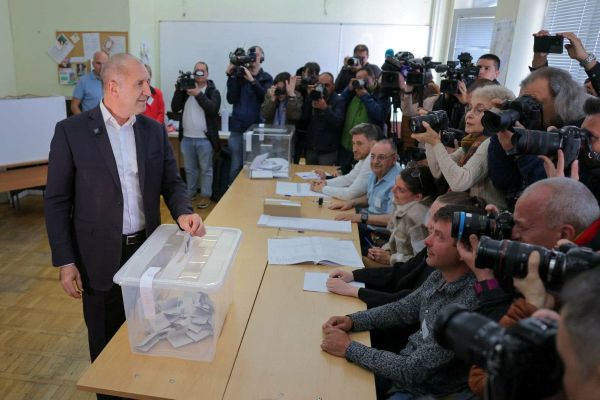
Progressive Bulgaria (PB), the party of Bulgaria’s pro-Russian former President Rumen Radev, was leading in Sunday’s parliamentary election with 44.69% of votes, after 91.68% of votes were counted, according to the official results.
While exit polls predicted that Radev would not reach the majority needed to form a government and seek a partner, his party won more than the 121 seats needed for a majority in the 240-member National Assembly.
Notably, only five parties and coalitions have surpassed the 4% threshold required for entry into the National Assembly. Voter turnout was recorded at 48.5%.
Radev’s PB may win up to 130 seats in the parliament.
The GERB-SDS of Boyko Borissov received the 13.39% of the votes, electing 39 seats and losing 27. Also, 39 seats, two more than in the previous parliament, were won by the liberal We Continue the Change – Democratic Bulgaria (PP-DB) coalition with 13.21%. The Movement for Rights and Freedoms (DPS), led by the controversial politician Delyan Peevski, loses 11 seats, electing only 18 MPs with 6.23%. The right-wing extremist Revival faced an electoral catastrophe, receiving only 4.35% (narrowly below the 4% threshold), losing 20 deputies, and electing only 13.
Radev’s Russophilia may create problems
President from 2016 to 2026, Radev resigned on 23 January to form a new political party, having been critical of the previous coalition government, which resigned in December amid protests over tax increases and corruption. Radev, known for his populist rhetoric, stated during his electoral campaign that the PB coalition aims to address corruption tied to the oligarchic model by relying on the collective voice of the people.
However, Radev’s Russophilia may lead to new conflicts within the EU when he becomes prime minister. During the previous unstable political period, Radev has supported the protests and expressed scepticism about adopting the euro. He has aligned with the Kremlin on the Ukraine conflict and opposes sanctions against Russia. He also supports reopening the EU-Russia dialogue.
Mario Bikarski, a senior Eastern and Central Europe analyst at Verisk Maplecroft, told the Associated Press that although Radev has officially condemned Russia’s invasion of Ukraine, he has consistently opposed military aid to Kyiv and favoured resuming dialogue with Russia to resolve the conflict.
“Rumen Radev is what Boyko Borisov was in 2009 and Simeon Saxe-Cobourg-Gotha was in 2001. Cyclical occurrence in Bulgarian politics. Big unknown is his staying power once he takes responsibility for running the country. Radev’s core electorate migh prove much narrower over time,” Dimitar Bechev, an experienced analyst and author specialised in Russia, Turkey and the Balkans, commented on X. Bechev characterised Radev as “an Orbán-lite figure.”
However, Evelina Slavkova, a representative from the Trend research centre, has suggested that Radev is unlikely to make significant efforts to pivot Bulgaria further towards Russia. “Our country has succeeded, despite facing various obstacles and differences among certain politicians, in developing a robust framework that maintains Bulgaria on the right path,” she said in an interview with The Associated Press.
Slavkova emphasised that Bulgaria’s membership in NATO and the European Union, along with its participation in the eurozone and the Schengen Area, are essential tools that enhance the nation’s stability.
Additionally, she observed that during the campaign, Radev tended to avoid giving unequivocal yes-or-no responses, aiming to balance competing perspectives. “While this approach may be acceptable during a campaign, it becomes imperative to offer clear and definitive answers when governing,” Slavkova remarked.
