
The European Union announced on Monday its intention to explore methods for ensuring the continued accessibility of the Strait of Hormuz amidst rising energy and commodity prices, exacerbated by the ongoing conflict involving Iran, Israel, and the United States.
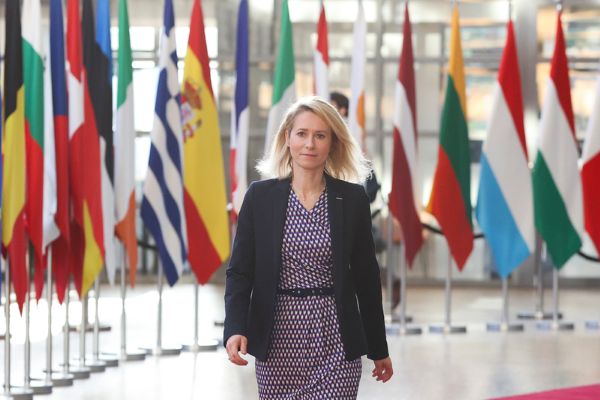
“It is in our interest to keep the Strait of Hormuz open, and that’s why we are also discussing what we can do in this regard from the European side,” said Kaja Kallas, the EU’s foreign policy chief, ahead of a meeting of the 27-nation bloc’s foreign ministers in Brussels on Monday.
US President Donald Trump has sought the assistance of international allies—including France, China, Japan, South Korea, and Britain—to safeguard the strait for global shipping.
Kaja Kallas indicated that the EU could consider expanding its existing Aspides naval mission, which currently protects shipping in the Red Sea, to include operations in the Persian Gulf. Alternatively, the EU may form a “coalition of the willing,” allowing member states to contribute military resources as needed.
The conflict in Iran, instigated by airstrikes from Israel and the United States on 28 February, has resulted in a notable increase in global energy prices, with Brent crude rising by over 40%.
Furthermore, the war has disrupted the broader global supply chain, affecting a range of goods, from pharmaceuticals sourced in India to semiconductors from Asia, as well as oil-derived products such as fertilisers originating in the Middle East. This situation has left numerous cargo ships stranded in the Gulf or compelled to navigate significantly longer routes around the southern tip of Africa.
Additionally, flights transporting air cargo from the Middle East are presently grounded. The prolonged nature of this conflict raises concerns about potential shortages and price increases across sectors.
France has communicated its ongoing collaboration with various countries—acknowledging partners in Europe, India, and Asia—to discuss a possible international mission to escort vessels through the strait. However, this initiative is contingent upon favourable conditions, specifically a de-escalation of hostilities.
German Foreign Minister Johann Wadephul stated on ARD television, “Will we soon be an active part of this conflict? No.”
Luxembourg Foreign Minister Xavier Bettel underscored that the EU has yet to commit to any military intervention, noting, “The fact is, at this moment, the EU is not directly involved in the situation. We need to decide regarding our participation, which is a crucial decision.”
Operation Aspides was initially established to mitigate threats to shipping in the Red Sea posed by Somali pirates and the Iran-backed Houthis, who have not yet engaged in the current conflict. Additionally, Saudi Aramco oversees a pipeline network that bypasses the Strait of Hormuz, transporting oil to the Red Sea port city of Yanbu.
“If we want to have security in this region, then it would be easiest to actually already use the operation that we have in the region and maybe change a bit,” Kallas said.
“There is also talk of coalition of the willing in this regard, but we also need to see what could be the fastest to provide this opening for the Strait of Hormuz, but of course, as you can see, it’s not easy.”
The EU is anxious that a potential refugee crisis in Iran will develop if the war continues.
“Although for now, the conflict has not translated into immediate migratory flows toward the EU, what the future holds remains unclear and necessitates the full mobilisation of every migration diplomacy tool we have at our disposal,” said European Commission President Ursula von der Leyen in a statement Sunday.
This article used information from The Associated Press.
