
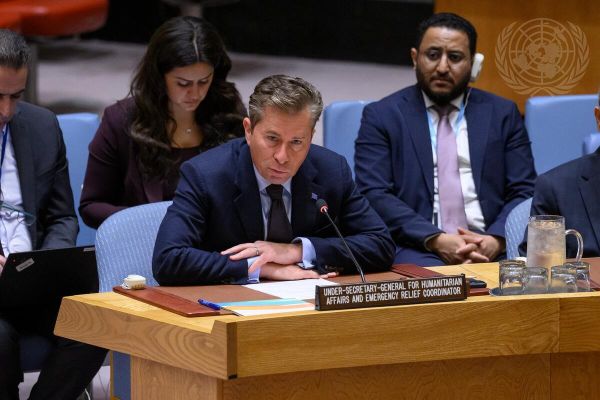
The increasing deployment of drones targeting civilians and humanitarian workers represents a significant challenge to aid operations in Ukraine, as highlighted by Tom Fletcher, the United Nations’ humanitarian chief. In a recent interview with The Associated Press following his visit to Kherson, Fletcher shared insights on the struggles faced by local communities living under the persistent threat posed by Russian drones.
He characterised his observations in Kherson, which is divided by the Dnipro River—a current front line—as “quite chilling.” On the eastern bank, Russian forces are in control, while Ukrainian forces maintain their position on the western bank. From across the river, both kamikaze and surveillance drones frequently seek out and attack civilians, vehicles, and public transportation.
“It really gives us an insight into the dangers ahead of us,” he said.
The ongoing threat is hindering humanitarian organisations from reaching those in need. Fletcher spoke after attending a memorial for two humanitarian workers who lost their lives while performing their duties.
“Drones are a real threat not just to civilians but to the humanitarians who are here to protect them,” Fletcher said.
He stated that international humanitarian law protects aid workers, yet marked humanitarian vehicles continue to be targeted. “This does limit our operations,” he explained. Local organisations are especially vulnerable, as more than two-thirds of the operations funded by Ukraine’s humanitarian fund are carried out by these groups, according to Fletcher.
“They’re the ones who are saying most loudly to us, we’re not protected,” he said.
Fletcher announced that the UN needs over $2 billion for humanitarian efforts in Ukraine this year, especially with winter approaching. Damage to infrastructure could leave millions vulnerable. Currently, 92 million people worldwide require urgent assistance due to various crises. The UN aims to raise $23 billion, having secured about $11 billion thus far. While Ukraine is better funded than other crises, it still faces significant needs, and raising funds has become increasingly difficult.
“We’re in a more transactional world, I would say a more selfish world,” he said.
Fletcher stated that the UN must now show it is using limited taxpayer money efficiently and strategically.
“We have to show governments that we are spending their taxpayers’ money sensibly, wisely, in a prioritised way,” he said.
A recent assessment released by the UN highlights a troubling situation, revealing that 907 aid workers were victims of violence last year, and over 1,000 have lost their lives in the past three years. Fletcher stated that he could not assure his colleagues that those responsible for these acts would face accountability, citing the international community’s inadequate response. He emphasised that accountability must extend beyond merely identifying the individual who executed the attack.
“I want to see investigations into the people who fired the weapon or flew the drone,” he said.
