
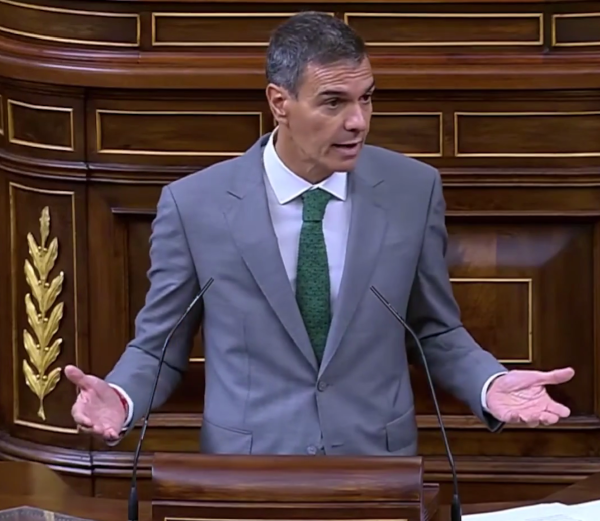
Spanish Prime Minister Pedro Sánchez announced early general elections for 29 November, moving the vote up by about eight months to capitalise on housing protests across the country. However, this decision carries risks, as the far-right party VOX, which placed third in the July 2023 elections, is gaining ground and could form a coalition with the conservative People’s Party (PP), ending one of Europe’s most prominent progressive governments.
Recent protests demanding solutions for Spain’s housing crisis have intensified, particularly after the eviction of an 87-year-old woman in Madrid sparked public outrage. Sánchez’s government recently faced a defeat when right-wing opposition parties blocked emergency measures to address evictions and real estate speculation.
In a national address, Sánchez highlighted that a broader progressive coalition in Parliament would empower Spaniards to tackle the country’s most pressing issues. “The time has come for the Spanish people to decide what future you want for yourselves and your country,” he stated, urging voters to choose between the far-right’s rollback of progress and maintaining Spain as a bastion of openness and social justice.
Sánchez, 54, has been Spain’s prime minister since 2018, making him one of Europe’s longest-serving leaders. He has gained recognition as an international progressive voice, advocating for migration, supporting Palestinians, and calling for AI regulation. His tenure has seen one of the fastest-growing economies in the developed world.
However, he faces challenges from legal cases involving his party and struggles to address the ongoing humanitarian crisis in Ceuta, where a surge of mostly Moroccan migrants occurred this summer. Since 2023, he has led a coalition government with the left-wing partner Sumar, but his reliance on smaller parties has complicated legislative efforts.
Analysts believe he aims to leverage his party’s recent momentum on housing and public services. At the same time, the opposition People’s Party plans to focus on corruption and the government’s handling of the Ceuta crisis.
“Sánchez is choosing this moment because it is arguably the best time to do so, given that the issue of housing frames the electoral conflict or debate in terms that are highly favourable to (his party’s) position,” Oriol Bartomeus, a professor of political science at the Autonomous University of Barcelona, told The Associated Press. “Sánchez can frame the election — or has realised he can frame it — in very classic left-versus-right terms,” Bartomeus said.
The Socialist leader is set to compete against Alberto Núñez Feijóo, the leader of the PP, who seeks to assume control of the government. “At last, the Spanish people will decide,” Feijóo said on Monday after announcing a snap election. “These elections differ significantly from previous ones in our democracy. This is about Spain overcoming Sánchez and what he represents,” he asserted.
This election may also pave the way for a coalition government that includes the far-right party VOX alongside the PP. At the regional level, the two parties have taken similar positions, and several prominent local figures within the PP support such an alliance. Recent progressive legislation introduced by Sánchez, including a law that allows migrants to obtain legal working status in Spain, has incited considerable opposition from both PP and VOX.
Recent polling data, conducted before Sánchez announced the snap elections and published on 5 October, showed that the People’s Party garnered over 32% of voter support, while the Socialists approached 19%. VOX, which ranked third in the 2023 elections with 12.4%, is now expected to receive about 19% of the vote, while the leftist party Sumar holds 6.3% support. A total of 176 seats is required for a majority in the Congress of Deputies, suggesting that a coalition government may be the most viable outcome after the elections. The Cabinet must approve the formal dissolution of Parliament, which Sánchez convened on Monday.
Consequently, Feijóo will bear responsibility for establishing a democratic government for Spain, ensuring the country remains aligned with pro-European Union values, and mitigating the risk of instability, particularly from the pro-Moscow, irredentist, and anti-immigration party VOX, whose influence could significantly affect the country’s political and economic stability.
This article used information from The Associated Press.
