
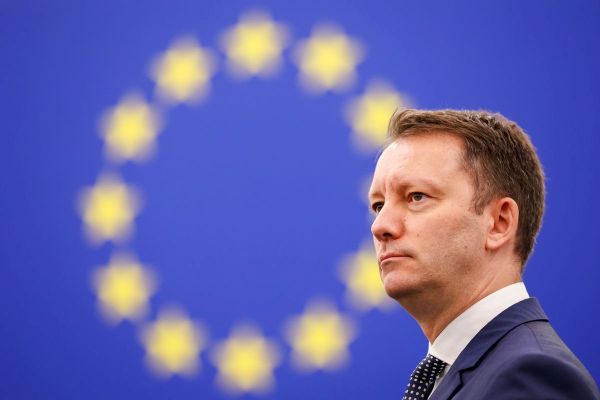
In a pivotal moment for Romania’s future, Parliament’s plenary session has begun deliberations on the government programme proposed by Siegfried Mureșan, followed by a vote on his government. To be inaugurated, a government needs at least 233 favourable votes from parliamentarians. However, Mureșan could not secure the required support, receiving only 182 votes.
This result was primarily driven by the Social Democrats (PSD) and the far-right Alliance for the Union of Romanians (AUR), the two parties that have played a significant role in instigating the current political crisis, thereby extending the period of instability and raising concerns about a potential economic downturn in the country.
In light of Mureșan’s defeat, President Nicușor Dan may consider requesting the Social Democrats to form a new government or may opt to call for early elections. He has previously indicated a preference to avoid elections, as Romania cannot sustain further political instability.
Sorin Grindeanu, the leader of PSD and a prominent figure in the ongoing crisis, stated, “We are ready to assume Romania’s recovery.”
However, if the President appoints Grindeanu as the new prime minister, the PSD leadership may risk pursuing a coalition with the extremist AUR. Recent statements from the Social Democrats suggest they may no longer dismiss the prospect of collaborating with AUR.
This party claims the legacy of Romania’s pre-war fascist movement and opposes the European Union, NATO, and any support for Ukraine. This pro-Kremlin party has also expressed alignment with the Trump administration and the MAGA movement.
Analysts have cautioned that such a coalition could undermine Romania’s efforts to address its budget deficit, which is currently the largest in the European Union.
Under a new government potentially supported by both the Trump administration and favoured by Moscow, Romania may be embarking on a course that could threaten not only its economic stability but also compromise the rule of law, democratic principles, and the safeguarding of human, minority, and social rights.
During a press conference in Prague, where he is on an official visit, Nicușor Dan announced that he will propose a new prime minister on Monday. He urged the parties to come to the consultation with “solutions that can pass.”
Stop Bolojan from saving Romania’s economy!
After taking office in June 2025, the coalition government under Ilie Bolojan focused on reducing the budget deficit. The PSD clashed with Bolojan over austerity measures, including tax increases and freezes on public-sector wages. Despite these challenges, the government implemented significant fiscal reforms.
In March, Grindeanu led the PSD to withdraw from the coalition. Despite positive economic developments and EU support, the PSD, in an “unholy” alliance with the AUR, submitted a motion of no confidence to Parliament on 28 April, intensifying the political crisis just two weeks before a favourable Commission assessment.
Revelations from the Wall Street Journal and Financial Times suggested that the actions of Grindeanu’s PSD and the AUR may be linked to US energy interests tied to the Trump administration.
PSD and AUR drive Romania’s economy towards bankruptcy
The ongoing turmoil has cost Romania billions of euros in lost European funds, while major rating agencies indicate the country’s sovereign debt is nearing “junk” status, below investment grade. Romania faces a credit rating downgrade to junk status, meaning its bonds would be considered unsuitable for investment. This concern stems from a prolonged political crisis that threatens the country’s fiscal integrity, Bloomberg reported, citing a Fitch Ratings analyst. S&P is expected to announce its latest decision on Romania’s rating on Friday, according to the Financial Times.
Nonetheless, on 14 May, the European Commission issued a favourable preliminary assessment of Romania’s fourth payment request for €2.62 billion under the Recovery and Resilience Facility (RRF), which is a key element of the NextGenerationEU initiative. Acknowledging the outcomes of the Bolojan administration, the Commission noted that Romania had satisfactorily met the requirements of 38 milestones and 24 targets outlined in the Council Implementing Decision. This achievement largely reflects the efforts of the previous government led by Ilie Bolojan, which enacted significant fiscal reforms to align Romania’s economic framework with its obligations as a European Union member.
Under Guilfoyle’s declaration shadow
A recent article in The Wall Street Journal, corroborated by an article published by the Financial Times, has affected Romania’s political landscape. According to the two media outlets, US Ambassador to Greece, Kimberly Guilfoyle, allegedly told the Greek Minister of Energy on 18 March that the Bolojan Government was likely to fall, stating, “We can do this in any country we want. We can do this here too,” at a dinner at the US Embassy in Athens.
According to the articles, after this dinner, Guilfoyle visited Bucharest, where she met with leaders of the Social Democratic Party (PSD) to promote a gas corridor known as the Vertical Corridor, running from Greece to Ukraine. While Prime Minister Bolojan supported the initiative, he was reluctant to increase purchases of American liquefied natural gas (LNG) because of Romania’s domestic resources. His hesitance contributed to the PSD’s decision to withdraw from the coalition.
Grindeanu denied any US agreement, and Siegfried Mureșan condemned the meeting between Guilfoyle and the Romanian Social Democrats as “conspiratorial,” emphasising the need for scrutiny and calling the matter “extremely serious.”
Mureșan proposed a realistic way out of the crisis
Before the vote, PSD and AUR announced they would oppose the proposed cabinet, while the designated prime minister called for support focused on reforms and accountability. The vote revealed that a majority in Parliament, comprising far-right and extremist parties along with PSD, seeks an anti-EU stance, despite Romania’s economy being closely tied to the EU.
Mureșan gained support from the centre-right parties PNL, USR, and UDMR, as well as national minority MPs. According to the Constitution, if Parliament rejects two investiture requests within 60 days, the President may dissolve Parliament after consulting with key leaders.
Ratings agencies warn that Romania must approve a 2027 budget with deficit cuts to maintain its low-level sovereign rating. As a result, the President, meeting with party leaders on Monday, may consider forming a technocratic government to avoid snap elections.
