
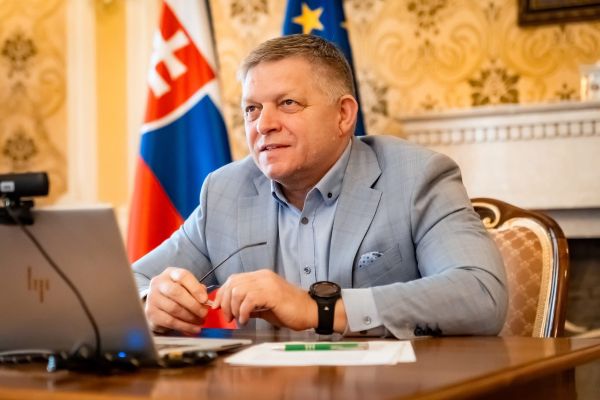
On Wednesday, Slovakia’s main ruling party, Smer-SSD, said sustaining the government’s majority will require significant effort and urged coalition partners to keep internal disputes from disrupting policymaking. This appeal for cooperation follows a recent vote by the far-right Slovak National Party (SNS), a junior partner within the nationalist coalition, which supported the parliamentary opposition in dismissing a minister. This event has raised concerns about the viability of Prime Minister Robert Fico‘s pro-Russian government as it will face an election after a year.
The government’s majority is now under threat after parliament voted to dismiss Deputy Prime Minister and Environment Minister Tomáš Taraba, who has lost the SNS leadership’s support.
Following the parliamentary elections in September 2023, a pro-Kremlin nationalist government was formed, comprising Fico’s Smer-SSD, the Hlas (Voice – Social Democracy) party led by Slovakia’s current President Peter Pellegrini, and the far-right SNS. This coalition has elicited concerns about Slovakia’s adherence to the rule of law and its foreign policy orientation. The three-party government also relies on several loyal independents to maintain control of 78 seats in the 150-member parliament.
Smer-SSD has called upon its coalition partners to engage in responsible governance, emphasising the imperative of approving a realistic budget for 2027. The party said Slovakia cannot afford temporary measures or a minority government at this critical juncture, especially given the geopolitical challenges stemming from conflicts in Ukraine and the Middle East.
“What Slovakia requires today is a stable government capable of making informed decisions, even if it relies on a slim parliamentary majority,” Smer-SSD said in a statement after a leadership meeting.
Under Fico’s administration, Slovakia has diverged from its European Union and NATO allies by maintaining amicable relations with Russia and continuing to import Russian oil and gas.
At a recent gathering of medical students in Prešov, Fico expressed concerns about the potential for war and his commitment to keeping Slovakia out of conflict. “I fear war,” he stated, adding that “the military conflict in Ukraine has escalated beyond control.” He cautioned students to envision Slovakia being asked to prepare troops for unclear engagements.
Fico referenced Article 5 of NATO’s founding treaty, which regards an armed assault on one member as an assault on all. “I do not wish for Slovakia to become embroiled in any military conflict as a result of Article 5,” he emphasised. “While we value our membership in NATO, I will take all necessary measures to ensure that Slovakia remains uninvolved in military confrontations.” Critics contend that his comments may undermine NATO, which was established to avert such conflicts.
In the event of a snap election, however, opinion polls suggest that the ruling parties could potentially lose power. Fico’s government has observed a marked decline in popularity since 2023.
An Ipsos survey conducted from September 18 to 22 revealed that Smer-SSD’s support had diminished from 23% in the last elections to 16.9%. The other governing parties have fallen even more sharply: Hlas has dropped from 14.7% in 2023 to 6.6%, while SNS has plummeted from 5.6% to 2.2%. Given that the parliamentary entry threshold is 5%, and 7% for a coalition of two to three parties, SNS is unlikely to secure representation in parliament in a snap election.
Moreover, such results could pose significant challenges for both Smer-SSD and Hlas, potentially facilitating the formation of a pro-European Union coalition government. Growing discontent with Fico appears to favour other political entities, suggesting rising support for the pro-EU Progressive Slovakia (PS) at 19%, Conservative OĽaNO at 10.7%, the Christian Democrats (KDH) at 7%, SaS at 8.4%, and the Democrats at 5.5%.
