
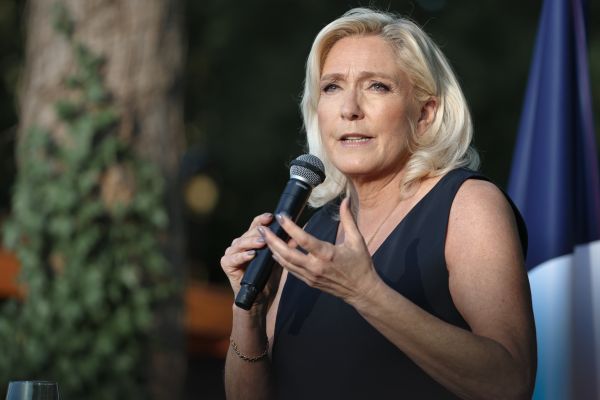
As France’s summer vacation season comes to an end, the campaign to replace President Emmanuel Macron next May is gaining momentum. An unusually large and diverse group of candidates is emerging, driven by Macron’s constitutional ban on seeking a third consecutive term.
This crowded field could benefit far-right candidate Marine Le Pen, reminiscent of her father, Jean-Marie Le Pen, in the 2002 election when a split vote helped him reach the second round.
Olivier Faure, the Socialist Party leader, recently declared his candidacy, joining over two dozen others considering a run in 2027. This election is poised to be one of the most significant globally next year, as France grapples with various challenges, including the impact of Donald Trump‘s presidency. No French presidential election campaign this century has occurred in such turbulent times.
After decades of efforts—first by her father and then by her—Marine Le Pen’s fourth campaign for the French presidency is shaping up to be a strong opportunity for her National Rally party, which is nationalist and anti-immigration. A victory could significantly impact the European Union by placing a critic of the bloc in charge of one of its leading member states.
“This is a crucial election, as the far-right may win for the first time,” said Gilles Ivaldi, a researcher at Sciences Po University. He noted that Le Pen’s presidency would likely weaken the EU and create instability.
Polls indicate that Le Pen is the front-runner, potentially advancing to the winner-takes-all runoff on 2 May—something she has not achieved in past elections where she fell short against Emmanuel Macron.
Le Pen has distanced herself from her father’s extremist legacy and is now seeing positive electoral results. Since 2024, her National Rally has become the largest party in the lower house of parliament. Additionally, a Paris appeals court recently lifted a ban on her candidacy stemming from previous legal issues, paving her way for another presidential run.
An uncertain picture
Marine Le Pen is expected to secure a spot in the decisive second-round runoff, but the fight for the other spot is highly competitive and uncertain. Her strongest opponents include leftist Jean-Luc Mélenchon, who aims for his first runoff after finishing third in 2022 and fourth in previous elections, as well as centrists Édouard Philippe and Gabriel Attal. Other notable contenders include former Interior Minister Bruno Retailleau and left-wing figures such as Raphaël Glucksmann and Marine Tondelier.
These candidates recently debated at Roland Garros in Paris, discussing proposals to address France’s economic issues and critiquing Le Pen. If polls suggest a potential Le Pen-Mélenchon final matchup, some candidates may withdraw to consolidate support behind mainstream alternatives. Analyst Ivaldi noted, “The more fragmented the field, the higher the chances that Mélenchon will be that person.”
However, this time, a critical international environment is influencing the French presidential election campaign. The Iran war has raised energy costs, while the war in Ukraine has increased fears about potential Russian aggression against NATO allies. Trump’s presidency has shaken French confidence in the trans-Atlantic alliance, and worries about China’s manufacturing power and the rise of artificial intelligence have made France anxious about being left behind economically and technologically.
Additionally, the country faces rising public debt, limiting the financial options for Macron’s successor. Many voters blame Macron for France’s troubles, expressing their frustration through protests during his presidency. The election may ultimately depend on whether voters support the extremes of Le Pen and Mélenchon or favour a safer mainstream candidate. “It will be interesting to see which of these forces prevails,” said Ivaldi, referring to the competing political extremes.
This article used information from The Associated Press.
