
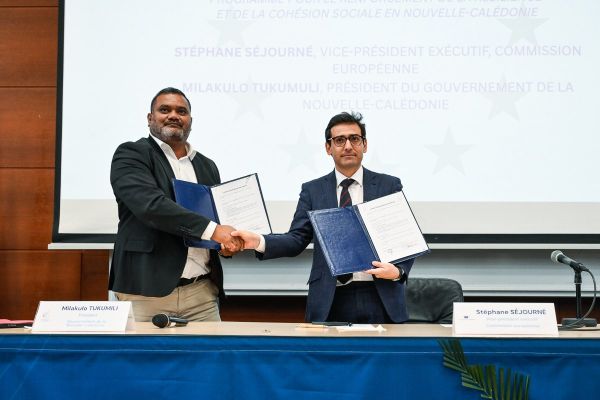
On 20 October, the European Commission and the New Caledonian government formally signed a Memorandum of Understanding (MoU) to establish a strategic partnership focused on sustainable raw-materials value chains. The agreement was signed in Nouméa, New Caledonia, by Stéphane Séjourné, the Executive Vice-President for Prosperity and Industrial Strategy, alongside Milakulo Tukumuli, President of the Government of New Caledonia, and Alcide Ponga, the Member of the Government responsible for the energy and mining sectors.
The MoU provides a political framework for collaboration between the European Union (EU) and New Caledonia in the raw materials value chains. As a prominent nickel producer, New Caledonia accounted for 3.1% of global production in 2024, underscoring its significant mineral potential and status as an Overseas Country and Territory (OCT). This partnership marks the EU’s 17th strategic alliance in raw materials since 2021.
“This agreement marks a new chapter in the relationship between the European Union and New Caledonia. Europe needs reliable partners to diversify its critical raw materials supply chains, and New Caledonia has the resources, industrial expertise and know-how to play a strategic role in this effort. Our ambition is clear: to make New Caledonia a preferred supplier for European industry, while making Europe a partner of choice for investment, financing and new industrial opportunities in New Caledonia. This is not just about securing nickel supplies for Europe. It is about creating value, supporting jobs and building a shared industrial future,” said Stéphane Séjourné, Executive Vice-President for Prosperity and Industrial Strategy.
The MoU delineates five primary areas of cooperation:
1. Economic and Industrial Integration: The parties will promote the economic and industrial integration of value chains for critical and other raw materials. This initiative will involve developing joint projects and facilitating access to financing to attract further investments aligned with the Global Gateway strategy and the Team Europe approach. Additionally, they will work to mobilise relevant instruments from the EU, Member States, financial institutions, and private investors.
2. Sustainable Economic Growth: There will be a concerted effort to ensure that New Caledonia’s minerals sector acts as a catalyst for sustainable and inclusive economic growth, emphasising local and domestic value creation. This includes the responsible exploitation of mineral resources, the rehabilitation and closure of mining sites, and adherence to stringent environmental, social, and governance (ESG) standards as outlined in EU legislation, agreements, guidelines, and best practices.
3. Infrastructure Development: The partnership will support the infrastructure necessary for the development of raw materials value chains, taking into consideration the specific transportation and energy infrastructure needs of New Caledonia.
4. Skills Development: There will be a commitment to enhance skills development along raw materials value chains through collaboration among educational institutions, vocational training providers, research organisations, and industry stakeholders.
5. Research and Innovation: The parties will collaborate on research and innovation on prospecting, exploration, extraction, processing, recycling technologies, refining, material substitution, and circularity of raw materials, in addition to innovative methods for the closure and rehabilitation of mining sites.
“New Caledonia’s mineral resources offer real opportunities to drive economic development and create lasting value for its people. Through closer cooperation, we can strengthen local industries, encourage investment and foster innovation, while ensuring that growth goes hand in hand with high environmental and social standards. This partnership also offers an opportunity to strengthen links between our industries and make our raw materials supply chains more resilient and diversified. Through Global Gateway, we want to build a partnership that supports long-term prosperity in New Caledonia and creates shared opportunities for the future,” added Jozef Síkela, Commissioner for International Partnerships.
Following the MoU’s signing, the EU and New Caledonia will jointly develop a roadmap in consultation with all EU Member States, the European Investment Bank, industry representatives, and other partners. This roadmap will encompass specific actions designed to implement the strategic partnership effectively.
