
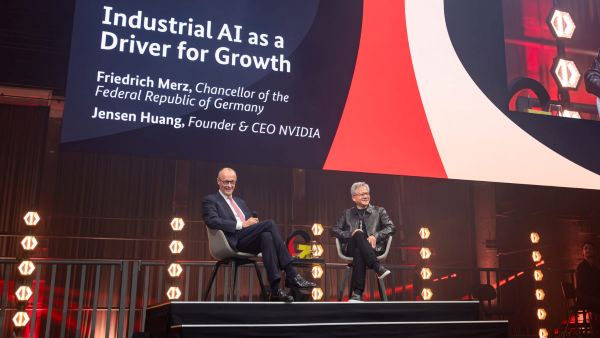
Nvidia CEO Jensen Huang has urged Germany’s automotive and industrial machinery sectors to quickly adopt artificial intelligence to revitalise the country’s evolving business model by leveraging its abundant manufacturing data and expertise.
Huang, whose company develops advanced computer chips and software utilised by organisations such as Anthropic and OpenAI for AI application development, asserted that digital technology will not supplant the manufacturing and engineering sectors where Germany has significant proficiency. As he articulated, “electrons will never replace atoms.” Nevertheless, he highlighted the industry’s potential advantages in embracing technological advances.
“The next wave of AI is physical. This is where AI interacts with the physical world: robotics, manufacturing, cars, heavy industry,” Huang said Monday during a discussion with German Chancellor Friedrich Merz at an investment conference in Berlin.
“And so AI can only augment your capability. It will not replace your capability. So take advantage of the technology,” he added.
Huang emphasised that Germany’s manufacturing expertise is a valuable resource, but the country needs to utilise artificial intelligence (AI) better. He warned, “This industrial revolution is so mighty, so powerful. You don’t have another chance.” European leaders, including Merz, recognise AI as a potential growth driver but are concerned about reliance on US tech companies.
Europe has rich public-sector and machine-readable manufacturing data that could boost AI development, a point former European Central Bank head Mario Draghi stressed. Huang and Merz identified AI as an opportunity for Germany’s “mittelstand,“ the small- and medium-sized enterprises in specialised sectors.
Merz is working to revive Germany’s economy, which has faced stagnation due to high energy prices, competition from China, and regulatory burdens. This has affected the export of complex machinery, including cars and trains. Europe also lags behind the US in building the data centres needed for AI training and faces security concerns about sensitive data stored on US servers. Huang suggested that Germany should import AI technology while safeguarding its cultural values and knowledge.
Huang said Germany should “take advantage of artificial intelligence. Let them codify, let them programme, let them teach this artificial intelligence and keep it here in Germany, and let’s re-engineer, the chancellor’s words, Germany. This is your chance to do it.”
This article used information from The Associated Press.
