
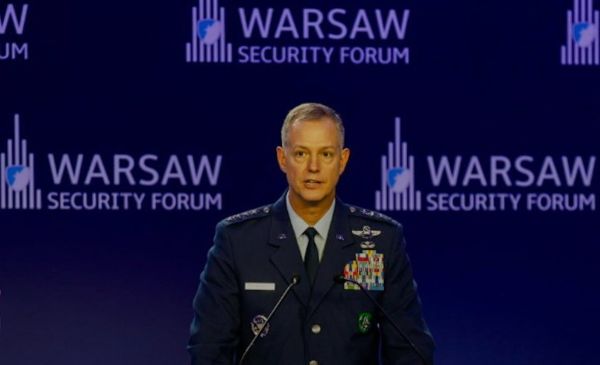
NATO’s top military commander declared that the alliance is “ready to fight tonight” if attacked, amid warnings from European officials about potential Russian covert operations or limited military incursions.
Recent months have seen an increase in Russian activities, including an arson attack on an Estonian defence company and a failed attempt to strike a Ukrainian aircraft at a German airport.
If Russia attacks NATO, the alliance will respond with sensors, autonomous systems, and military force, according to US General Alexus Grynkewich. Speaking at the Warsaw Security Forum, he emphasised that while he doesn’t foresee an imminent conflict, the best way to preserve peace is to prepare for war and keep communication open to resolve misunderstandings.
NATO will break the enemy’s forces if necessary, Grynkewich says
Grynkewich did not specify details of NATO’s preparations for a potential attack, including locations or the forces involved. However, he indicated that NATO’s combined land, sea, and air forces would work to prevent Russia from seizing and holding territory.
“My theory of victory is simple,” he told the Warsaw conference.
“We will block the initial attack. If the attack persists, we will blunt it and prevent any enemy advance. And if required, we will break the enemy’s forces and the operational war-fighting system arrayed against us.”
The situation involves not only the attacking force but also all supporting elements. Recently, European officials have warned that Russia may test the NATO alliance with covert attacks or incursions, particularly following a series of sabotage incidents. Denmark’s defence intelligence service specifically cautioned that Russia could attempt to create divisions within NATO.
At the same time, President Donald Trump has sparked concern in Europe by agreeing to buy diesel from Russia to lower US prices ahead of the midterm elections. Earlier this year, he announced the withdrawal of American troops from Europe, and his conflict with Iran has resulted in critical shortages of advanced air defence missiles in the region.
“Ultimately it’s a political decision as to where troops are deployed, but no one should question the US commitment to the alliance,” Grynkewich said. Grynkewich said alliance members should coordinate a “coherent” response to Russian activity to make it clear to Moscow “where our red lines are.” The response to increased Russian malign activity and sabotage, he said, should be to double down on support for Ukraine.
NATO countries facing readiness gaps in threat response
Polish Prime Minister Donald Tusk has warned that Russia may escalate tensions with drone or rocket strikes on European allies supporting Ukraine. Denmark’s Defence Intelligence Agency noted a “low but growing risk” of a limited military attack on NATO countries bordering Russia. NATO is prepared for such an attack and is “unlikely to be caught by surprise,” according to Grynkewich.
While NATO aims to defend against Russian aggression using sensors and autonomous systems, some member countries have struggled with drone warfare exercises and detecting drone incursions. Several attack drones have crashed in NATO countries near Russia, Ukraine, and Belarus. In May, residents of Vilnius, Lithuania, were advised to seek shelter after a drone entered their airspace.
NATO spokesperson Colonel Martin O’Donnell said countries are deploying ground sensors and technology to counter drones and establishing a network to connect these systems. However, no drones have been intercepted yet.
More than 200 incidents since 2022
In September, Germany accused Russia of plotting to use a drone loaded with explosives to attack a Ukrainian aircraft at Leipzig Airport. British officials reported thwarting a Russian scheme targeting a drone facility near London, while Estonia linked Russia to a fire at a defence company. These incidents are part of at least 211 attributed to Russia by Western officials since Moscow’s invasion of Ukraine.
Denmark’s defence intelligence service warned that Russia might acquire Ukrainian drones to launch attacks in Europe, presenting them as “accidental” to weaken NATO’s response. The goal would be to divert European resources from supporting Ukraine and create divisions within NATO. However, both the Danish service and O’Donnell noted that a direct attack on NATO would be difficult while Russia is focused on the conflict in Ukraine.
This article used information from The Associated Press.
