
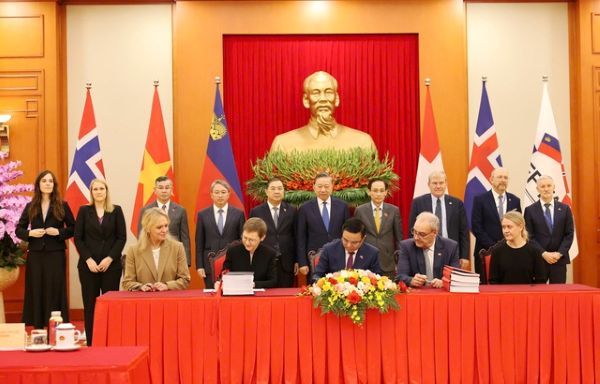
Norway, Switzerland, Iceland, and Liechtenstein have officially signed a free trade agreement with Vietnam. Vietnam’s trade ministry, in collaboration with members of the European Free Trade Association (EFTA), facilitated the signing on Sunday in Hanoi. After a lengthy hiatus, negotiations resumed last year amid global uncertainty over US tariffs and culminated in an agreement in July.
This trade deal marks a significant step forward in Vietnam’s diplomatic and economic relations with the four European countries. It underscores a shared commitment to enhancing economic cooperation and promoting free trade despite ongoing global economic challenges.
According to Vietnam’s trade ministry, the country primarily exports seafood, footwear, textiles, machinery, equipment, and electronics to the EFTA market, while importing industrial machinery, equipment, chemicals, pharmaceuticals, and raw materials essential for production.
Bilateral trade between Vietnam and EFTA member countries has consistently averaged $2 billion annually. The agreement covers a broad range of vital areas, including trade in goods and services, investment, intellectual property rights, government procurement, competition policies, support for small and medium-sized enterprises, dispute resolution mechanisms, and sustainable development initiatives.
This trade pact is expected to open new avenues for Vietnam to diversify its export markets and attract high-quality investment, advanced technologies, and modern governance expertise from leading European economies.
Established in 1960, the EFTA is an intergovernmental organisation of Iceland, Liechtenstein, Norway, and Switzerland.
Significant benefits for Norway
Norway stands to gain the most from the agreement. It will ultimately remove tariffs on nearly all goods Norway exports to Vietnam. When the agreement comes into effect, approximately half of Norway’s exports to Vietnam will be tariff-free, with over 98% expected to be tariff-free within seven years, according to a statement from the Norwegian government.
“In a more unpredictable world, Norway needs to diversify its trade relations. Since this Government took office, Norway has signed seven new free trade agreements. The agreement with Viet Nam opens new opportunities for Norwegian businesses and strengthens trade relations with a country that shares our commitment to rules-based trade. This is good news for Norwegian businesses and for the Norwegian economy,” said Minister of Foreign Affairs Espen Barth Eide.
Viet Nam currently imposes tariffs of up to 15 % on Norwegian salmon and mackerel. When the agreement enters into force, salmon can be exported tariff-free. Tariffs on mackerel will be phased out over three years.
“The agreement will give Norwegian seafood exporters conditions on a par with those enjoyed by key competitors and create opportunities for increased seafood exports to Viet Nam,” said Minister of Fisheries and Ocean Policy Marianne Sivertsen Næss.
The free trade agreement will promote increased investment and trade in services. It also features an ambitious chapter focused on trade and sustainable development. In recent years, trade between Norway and Vietnam has steadily grown. In 2025, the total trade in goods reached approximately NOK 19 billion.
“Viet Nam is one of the fastest-growing economies in Asia. This agreement will give Norwegian businesses better market access and greater predictability, and help them diversify as they create value and jobs here in Norway,” said Minister of Trade and Industry Cecilie Myrseth.
