
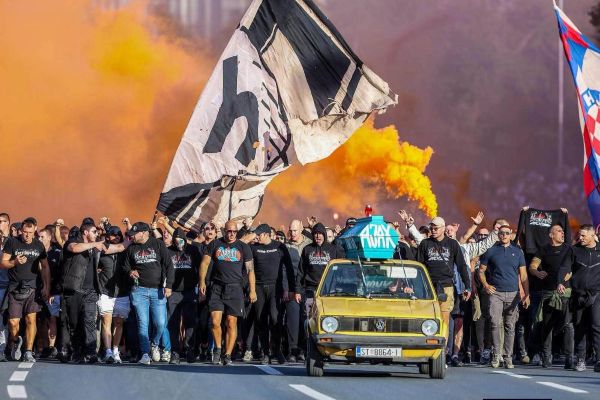
Law enforcement authorities in the Croatian city of Split arrested a minimum of twelve supporters of the Hajduk Split soccer team on Friday, in the aftermath of an incident that transpired the preceding evening. During this incident, a faction of unruly fans engaged in an antisemitic rally, confronted police officers, and interrupted a competitive match against the visiting Dutch team, Ajax.
Before the commencement of the match, several supporters partook in the chanting of derogatory remarks directed at the Jewish community and expressed admiration for Nazi leader Adolf Hitler. Noteworthy was their march behind a vehicle displaying a mock coffin inscribed with the name of Ajax, a club historically associated with Amsterdam’s Jewish populace.
Such behaviour has drawn widespread denunciation across Croatia, including strong criticism from President Zoran Milanović and the conservative government, both of whom have called for accountability and consequences.
On Friday, law enforcement officials confirmed the arrest of twelve individuals on charges of inciting violence and hatred, with indications that further arrests may be imminent. Supporters also clashed with police, culminating in a twelve-minute match interruption after flares and other projectiles were projected onto the playing field. Ultimately, Hajduk won 2-1, marking the club’s first significant European match in sixteen years in the third-tier Conference League.
The Croatian Football Association issued a formal statement saying the incident has adversely affected the country’s standing in sports, asserting that such conduct is fundamentally antithetical to the core values of respect, tolerance, and unity essential to athletic competition.
President Milanović has advocated for the implementation of measures and sanctions that unequivocally signify a rejection of Nazism and related ideologies within the nation.
The Croatian government has been subject to scrutiny for purportedly neglecting the emergence of nationalist and extremist sentiments, particularly those associated with the country’s World War II regime, which collaborated with Nazi forces—an assertion that the government has refuted. Milorad Pupovac, a representative of the political interests of ethnic Serbs in Croatia—who suffered grievously under the pro-Nazi regime during the war—remarked that the occurrences in Split were foreseeable given the historical context. During World War II, a significant number of ethnic Serbs, Jews, Roma, and anti-fascist Croats tragically perished in concentration camps situated within Croatia.
Notwithstanding this distressing historical backdrop, certain nationalist factions within Croatia have appropriated pro-Nazi chants as emblematic of their struggle for independence from a Serb-led former Yugoslavia. The incidents in Split have also drawn condemnation from the Israeli Embassy in Zagreb, which expressed profound shock and called for an expeditious and decisive governmental response.
Furthermore, the Hajduk Split team may face disciplinary action from the Union of European Football Associations for the disruptions during the match. The club issued a formal apology for its fans’ conduct, emphasising that such behaviour does not reflect the views or values of the broader supporter base. The statement concluded, “Despite our best efforts, regrettable incidents transpired, and we stand ready to accept the ensuing consequences as a club.”
This article used information from The Associated Press.
