
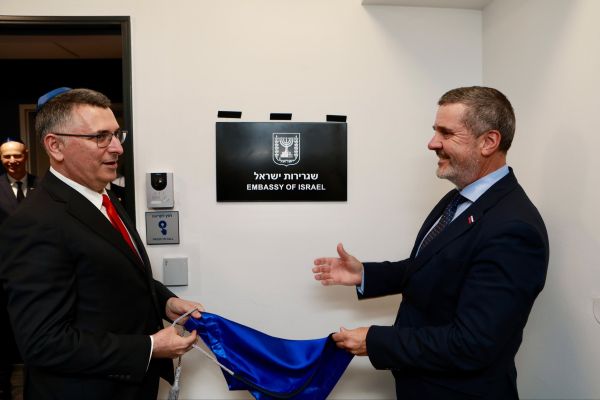
On Wednesday, Israel inaugurated its first embassy in Slovenia. This move strengthens diplomatic relations with the EU member state amid increasing tensions with some traditional allies over its stance on illegal settlements in the occupied West Bank. Israeli Foreign Minister Gideon Sa’ar travelled to Ljubljana for the event, signalling a shift in Slovenia’s diplomatic approach under right-wing populist Prime Minister Janez Janša.
Minister Sa’ar characterised the embassy opening as a “historic day” following discussions with his Slovenian counterpart, Tone Kajzer. He articulated that Israel is “the only democracy in the Middle East and one of Europe’s most significant partners.” Furthermore, he emphasised Israel’s role in safeguarding Europe’s security, asserting that “Israel serves as a fortress on the front line for Western civilisation.”
In contrast, hundreds of pro-Palestinian demonstrators gathered outside the newly opened embassy to protest and advocate for its closure. Minister Kajzer said the embassy’s opening would foster “greater dialogue, stronger cooperation, and, most importantly, tangible benefits for our citizens,” in a foreign ministry post on X.
This embassy inauguration comes after the United Kingdom decided to prohibit trade with Israeli settlements in the occupied West Bank, followed by similar announcements from France and Canada. Such actions are viewed as a symbolic demonstration of discontent from some of Israel’s closest allies, indicating a trend of increasing isolation for the Israeli government due to the ongoing conflict in Gaza. In response, Israel announced its intention to close the British consulate in Jerusalem.
Right-wing populist Janša breaks with policy of past government
The previous Slovenian centre-left government, led by former Prime Minister Robert Golob, was a prominent critic of Israel within the European Union. However, since assuming office in early June, Prime Minister Janša has enacted a significant shift in this policy. Following his electoral victory, Janša received commendations from various leaders, including Viktor Orbán, the former Prime Minister of Hungary, and Israeli Foreign Minister Gideon Sa’ar.
During Golob’s tenure, Slovenia was among the few EU countries to formally recognise an independent Palestinian state in 2024. Over the past year, his administration implemented an arms embargo on Israel in response to the military operations in Gaza and issued strong criticisms of Prime Minister Benjamin Netanyahu‘s actions. Slovenia also served as a non-permanent member of the United Nations Security Council during this period.
Reports before the elections indicated that Janša had engaged with officials from the Israeli private intelligence firm Black Cube. While he acknowledged consulting with an advisor from Black Cube, Janša has firmly denied any allegations of misconduct. Upon taking office, he promptly removed the Palestinian flag from the Slovenian government building, where it had been displayed alongside the flags of Slovenia, the European Union, and Ukraine. His government subsequently rescinded all measures previously enacted against Israel.
In a recent statement, Janša affirmed that his administration is focused on rectifying the policies of the former administration, asserting, “The economic damage alone due to the anti-Semitic policies of the Golob coalition is enormous.”
Golob has expressed concerns regarding his successor’s approach, accusing Janša of obstructing the EU from adopting a stronger stance on illegal settlements. In an interview with The Associated Press, he remarked that the recent embassy opening represents “another step in the same direction of shifting away from international law.” The Freedom Movement party, led by Golob, announced on Wednesday its intention to seek the removal of Janša and Foreign Minister Kajzer in Parliament.
In August, media reports suggested that Slovenia exerted pressure on the EU to dilute a statement condemning Israeli settlements, which drew both domestic criticism and praise from Israeli officials. Foreign Minister Kajzer stated that Slovenia has not obstructed discussions but is instead “constructively contributing” to the dialogue.
Political analyst Andraz Zorko noted that this significant policy shift may not align with the prevailing public sentiment in Slovenia. He observed that “the majority of the Slovenian public is either against Israel or holds a neutral position.”
Previously, Israel’s embassy in Vienna oversaw the country’s diplomatic interests in Slovenia. On Wednesday, Kajzer and Sa’ar signed a multi-sector cooperation agreement encompassing education, science, culture, youth, and sports, as reported by the STA news agency. Additionally, a business forum is currently taking place in Ljubljana.
This article used information from The Associated Press.
