
The European Union and the Philippines have reached a significant preliminary agreement on a new free trade deal, reflecting Brussels’ strategic effort to diversify its economic partnerships amid rising tensions with traditional trading partners such as China, Russia, and the United States. European Commission President Ursula von der Leyen announced this milestone on social media, stating, “We just agreed on a free trade deal.” However, EU officials later clarified that further negotiations are needed to finalise the agreement.
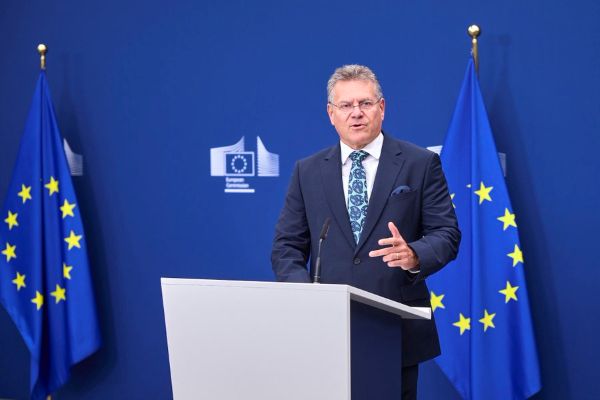
Maroš Šefčovič, Commissioner for Trade and Economic Security as well as Interinstitutional Relations and Transparency, alongside Philippine Trade Secretary María Cristina Aldeguer-Roque, is working towards enhancing the nearly €30 billion in annual trade between the 27-member EU and the Philippines, a Southeast Asian country with a population of 115 million.
Šefčovič expressed optimism about the agreement, describing it as a means to establish “a modern, forward-looking partnership” that would create new opportunities for exporters and investors, strengthen supply chains, and enhance bilateral economic ties for years to come. He anticipates that the agreement could be fully finalised within one to two years, contingent upon ratification by the respective parliaments.
Trade between the EU and the Philippines focuses mainly on electronics, with the EU exporting aircraft, pork, and pharmaceuticals and importing semiconductors, integrated circuits, and industrial machinery from the Philippines. The EU is actively seeking new trade connections from Australia to Argentina to build growth and stability amid geopolitical challenges, including conflicts in the Middle East and the ongoing war in Ukraine, which have disrupted traditional energy supplies.
The Philippines has already established trade agreements with two other ASEAN member states, Vietnam and Singapore. Furthermore, the European Commission is negotiating separate trade deals with Thailand, Indonesia, and Malaysia, while pursuing a broader free trade agreement with ASEAN as a long-term objective.
The challenges posed by Russia, China, and the United States to the EU include Russia-attributed hybrid warfare, a significant trade imbalance with China, and critical scrutiny from the US administration over European policies on defence, migration, and technology regulation.
The EU’s trade agreement with the Philippines aligns with the “middle powers” strategy articulated by Canadian Prime Minister Mark Carney at the World Economic Forum in Davos earlier this year. Last week, he served as the guest of honour during the annual State of the European Union address delivered by President von der Leyen in the European Parliament in Strasbourg.
During her address, she highlighted the EU’s intention to establish a novel form of “associate membership” for Canada, asserting that “in this new world, we must urgently reimagine our partnerships.” Meanwhile, nations worldwide have looked to the EU as a partner to navigate “sudden changes often affecting the fundamental principles of how trade is conducted,” as Šefčovič noted.
“My phone was ringing all the time,” he said. “When the world goes through such turbulence and turmoil, you work closely with your friends and close partners.”
This article used information from The Associated Press.
