
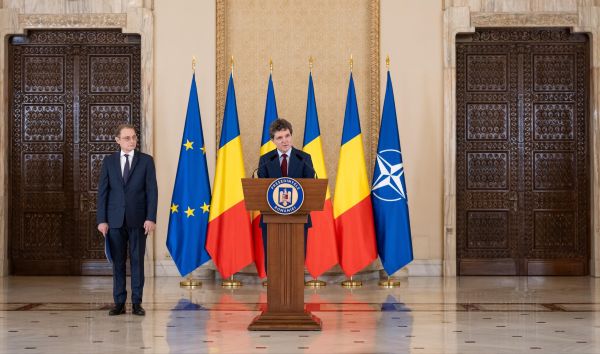
President Nicușor Dan has nominated diplomat Luca Niculescu for prime minister, the fourth nomination in the last five months. This decision followed about six hours of consultations with various parliamentary parties. Dan strives to address an ongoing political crisis that has increased debt costs and pressured Romania’s investment-grade rating.
This nomination reflects President Dan’s ongoing efforts to establish stable leadership after a pro-European broad coalition government collapsed following a no-confidence vote five months ago. However, it remains uncertain whether the political parties will support this new government.
“I chose an individual with the highest potential to secure a parliamentary majority. He retains the flexibility to determine the governing structure—whether political or technocratic—after engaging in discussions with the political parties,” stated Dan.
Dan further affirmed, “I am confident that a government led by Luca Niculescu will uphold Romania’s pro-Western orientation and will remain committed to the financial targets and obligations previously established by Romania.”
Luca Niculescu, 55, is a former journalist and served as Romania’s ambassador to France. He currently serves as interim deputy foreign minister, overseeing Romania’s ongoing accession process to the OECD.
Not an easy task
Niculescu has been given ten days to assemble a cabinet list and seek a vote of confidence from parliament. The nature of the government he will establish—whether political or technocratic—remains uncertain, as does the support he may receive from various political parties.
One potential avenue is restoring the previous coalition of PNL, PSD, UDMR, and USR. Alternatively, he may build his government around the PSD or opt for a technocratic approach.
The PSD may oppose Niculescu’s government, which could lead to a scenario in which it ultimately collaborates with the pro-Moscow right-wing extremist Alliance for the Union of Romanians (AUR). Such an arrangement could have negative consequences for both Romania and the PSD.
If these efforts to form a government fail, the option of calling snap elections may be considered. Analysts have indicated that the opposition AUR would likely be the primary beneficiary of such elections, as it currently leads opinion polls by a significant margin. These polls suggest that AUR would be the clear victor while traditional parties may struggle to gain traction. Dan has also said any new government should exclude AUR from its composition.
Pro-EU government collapsed under socialist and far-right alliance
A previous pro-European government, led by Ilie Bolojan of the Liberal Party (PNL), collapsed in early May. This happened when the Social Democrats (PSD), the largest party in parliament, withdrew their support and joined the right-wing extremist AUR to initiate a no-confidence vote.
The current situation raises uncertainty regarding whether the pro-European parties from the now-defunct coalition will endorse Niculescu’s upcoming cabinet. The range of reactions to Niculescu’s nomination highlights the complexities of resolving the ongoing political crisis.
The PSD has criticised AUR’s willingness to pursue early elections. Meanwhile, George Simion, AUR’s leader, has accused PSD leader Sorin Grindeanu of involvement in a scandal centred on Cristian Anton, head of the Romanian Road Authority (ARR) and Grindeanu’s former chief of staff. Authorities detained Anton in April on bribery and organised crime charges.
Political parties still don’t realise the gravity of the situation
After nominating Niculescu, party leaders met with the Prime Minister-designate to discuss his government’s programme.
PSD leader Sorin Grindeanu described his meeting with Luca Niculescu as productive. Grindeanu agreed to support Niculescu’s government if the centre-right National Liberal Party (PNL) and the Democratic Union of Hungarians in Romania (UDMR) also join, emphasising that without their commitment, the PSD would not back the government.
Grindeanu insisted the new government should abandon Ilie Bolojan’s reforms to save the economy and halt austerity measures. He demanded that PNL and UDMR support the PSD’s economic programme, which he believes Niculescu’s governing agenda will include.
Ilie Bolojan said the PNL will not participate in the government because it has decided not to govern alongside the PSD, although it is open to granting a vote of confidence. He rejected Grindeanu’s ultimatum for coalition support.
The UDMR is willing to vote for the new government without joining it, according to Árpád-András Antal, the mayor of Sfântu Gheorghe, after discussions with Niculescu. He described the meeting as sincere and constructive, focusing on the governing programme and Romania’s challenges.
Right-wing extremist AUR wants to govern
George Simion, leader of AUR, has raised concerns about a potential political manoeuvre against his party, which he describes as a “crumbling” operation. In a video message released on Thursday, Simion said a strategic plan has been developing over the past two months, intended to allow the PSD to maintain its position in government, possibly under Luca Niculescu’s leadership.
AUR has explicitly stated its opposition to supporting any government led by Niculescu. Additionally, in a statement on Tuesday evening, Simion said AUR is approaching a government transition, emphasising that it is merely a “matter of time” before the party assumes power.
Under Romanian law, the conditions for the president to dissolve parliament and call a snap election have been met; however, Dan has consistently said this measure would be considered only as a last resort.
No time to waste
This is a critical juncture for Romania, and it requires forming a pro-European Union government capable of preventing rating agencies from downgrading the nation’s economy. All three leading rating agencies have assigned Romania the lowest tier of investment-grade status, with a negative outlook in their scheduled reviews this year. They have underscored the importance of passing the 2027 budget by the end of the calendar year and outlined further steps to reduce the deficit.
This article used information from The Associated Press.
