
Political tensions rose on Tuesday over the European Union’s next long-term budget, as pressure mounts to finalise the spending package before unpredictable election results, driven by the rise of far-right parties, in major member countries next year. The multiannual financial framework (MFF) accounts for about 1.2% of the EU’s gross national income and is funded by member states based on their economies.
The budget, covering 2028 to 2034, is being negotiated amid external challenges like supporting Ukraine against the Russian invasion and navigating high energy prices and trade tensions with the US and China. Additionally, elections in France, Italy, Poland, and Spain could test the EU’s stability, with far-right parties currently leading in French polls and outcomes in Poland and Spain uncertain.
EU presidency unveils new proposal
Over the weekend, Ireland, holding the EU’s rotating presidency, proposed a €1.62 trillion budget. This is a 30% increase over the current seven-year package, but 8% less than the European Commission’s proposal.
Sweden, a net contributor, argues that “several hundred billion euros” in cuts are necessary. EU Affairs Minister Jessica Rosencrantz said the Irish plan would increase Sweden’s contribution by 60%, burdening taxpayers and limiting their ability to address domestic priorities.
Germany’s Chancellor Friedrich Merz supported Ireland’s efforts but remarked that an agreement is still far off. He emphasised that the EU budget must be affordable for its major contributors, saying, “Everyone must contribute to the necessary adjustments.” Merz will join discussions in Brussels on Thursday.
The term “everyone” referred to the countries rejecting cuts to cohesion funds for Europe’s poorer regions and agricultural subsidies, which together account for about two-thirds of the EU budget. If countries don’t agree to contribute more, Europe will need to reduce either agricultural or cohesion spending, or scale back its ambitions in defence and competitiveness, unless it finds new funding sources.
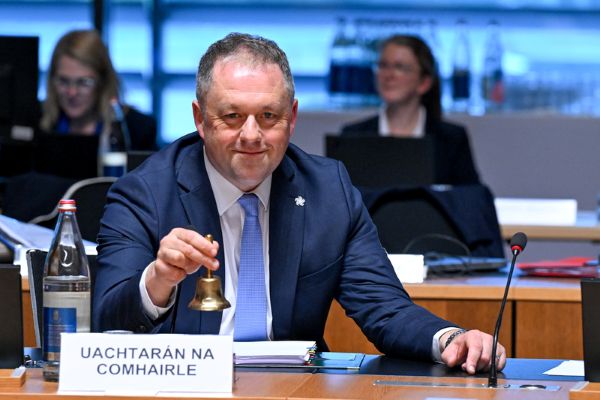
Despite the uncertainty, Ireland’s EU Affairs Minister Thomas Byrne believes the upcoming discussions have a solid foundation.
“That was our task, to find that basis,” he told reporters in Luxembourg before chairing Tuesday’s meeting. “We weren’t asked to find a basis for agreement. That will come later.”
“Nobody’s going to get everything that they want. But we hope that there’ll be something there for everybody,“ Byrne said.
Desperately seeking new funding sources
Negotiations are advancing as EU ambitions rise amid global uncertainty, but many countries face diminishing fiscal flexibility. The MFF is small compared with national budgets, and countries like France, Italy, and Belgium oppose raising their contributions because of high debt. While the EU cannot impose taxes, it raises revenue through customs duties and value-added tax (VAT), and the European Commission is seeking new funding sources such as a carbon emissions trading system and a tobacco duty.
Even if the December deadline is missed, funds will not run out immediately; countries have an extra year to finalise spending legislation to ensure money flows by January 2028. European Council President António Costa, in a letter inviting leaders to the summit, stressed the importance of a timely agreement for economic predictability and stability. “I count on your leadership and collaborative spirit,“ he wrote.
This article used information from The Associated Press.
