
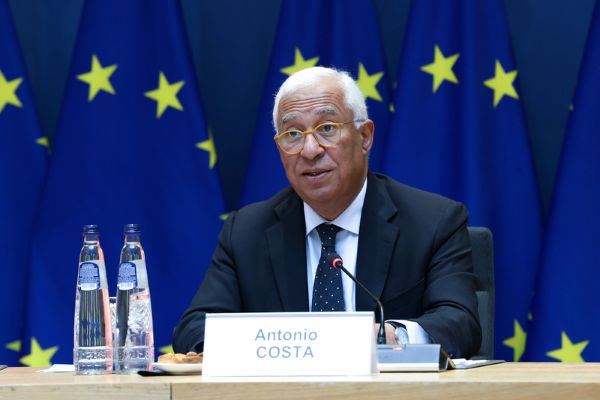
In a speech to EU ambassadors in Brussels on Tuesday, the EU Council President, António Costa, said that from the war in the Middle East emerges only one winner: Russia.
Russia “steadily undermines Ukraine’s position by flouting international law. It gains new resources to finance its war against Ukraine as energy prices rise. It profits from the diversion of military capabilities that could otherwise have been sent to support Ukraine. And it benefits from the reduced attention to the Ukrainian front as the conflict in the Middle East takes centre stage,” explained Costa.
The EU Council president told ambassadors that the EU must pursue a multidimensional foreign policy, “actively engaging with the international community to uphold the principles enshrined in the United Nations Charter and international law.”
Multilateral solutions for a multipolar world
Costa emphasised that it is in the EU’s interest to maintain a rules-based, cooperative world and to avoid further fragmentation.
“This is the best way to help Ukraine achieve a just and lasting peace. It is essential for Europe’s security and prosperity,” he said.
Costa said that Africa, the Americas, the Middle East, Asia, and the Arctic share land and maritime borders with the EU and are thus all its neighbours.
“With them we have historical and cultural bonds, economic and diplomatic ties. In times of polarisation and fragmentation in the world, Europe’s global vision is a true strategic asset.”
EU Council president explained that such a multipolar world requires multilateral solutions and “not spheres of influence, where power politics replace international law.”
“We know the new reality: a reality in which Russia violates peace, China disrupts trade, and the United States challenges the international rules-based order,” he emphasised.
In this new reality, the EU has a new mission, Costa said. It must defend the rules-based international order and maintain the principles enshrined in the United Nations Charter, as outlined in our Treaties.
“Violations of international law must not be accepted – whether in Ukraine, Greenland, Latin America, Africa, in Gaza or the Middle East. Human rights violations must not be tolerated – whether in Iran, in Sudan, or in Afghanistan,” elaborated Costa.
He further recognised that the war in the Middle East is of the utmost concern and said Iran is “for sure responsible for the root causes of this situation.”
“But unilateralism can never be the path forward. Attacks by Iran and its proxies, like Hezbollah, against its neighbours – including Cyprus, a member state of the European Union – must stop.” He said that the rapid response from Greece, France, Italy and Spain, sending military forces to protect Cyprus, is a powerful example of European autonomy and steadfast solidarity.
Human rights must be respected
He underscored that the EU urges all parties to exercise maximum restraint and return to negotiations. The EU stands with the enduring people of Iran and supports their right to live in peace and shape their own future, he said. Their human rights and freedoms must be fully respected.
“But freedom and human rights cannot be achieved through bombs. Only international law upholds them,” highlighted Costa.
He noted that the consequences of this war are severe, including in the economic sphere, as demonstrated by the Strait of Hormuz blockade.
Costa underscored that since the first day of Russia’s aggression against Ukraine, the EU has steadfastly supported Ukraine in financial, political, diplomatic, security, and reconstruction efforts.
In December 2025, the European Council approved a €90 billion loan, backed by the EU’s budget, to address Ukraine’s financial needs over the next two years. Costa emphasised that the EU remains committed to this promise and must continue to pressure Russia for a fair and lasting peace that respects Ukraine’s sovereignty and ensures Europe’s security.
EU is a reliable ally
Costa stated that the EU must expand its global partnerships, positioning itself as a reliable ally in an unpredictable world. As power politics resurface, the EU is striving for greater autonomy and resilience.
After designating 2025 as the year of European defence, Costa said that we must also declare 2026 the year of European competitiveness, as both are vital for Europe’s sovereignty. The EU’s strong response to U.S. threats regarding Greenland demonstrates how EU unity bolsters its global standing, Costa said.
“Because in times like these, values and trust are more critical than ever. They are the foundation of our influence and authority. This is what makes our Union powerful. This is what we must continue to stand for,” concluded the President of the European Council.
