
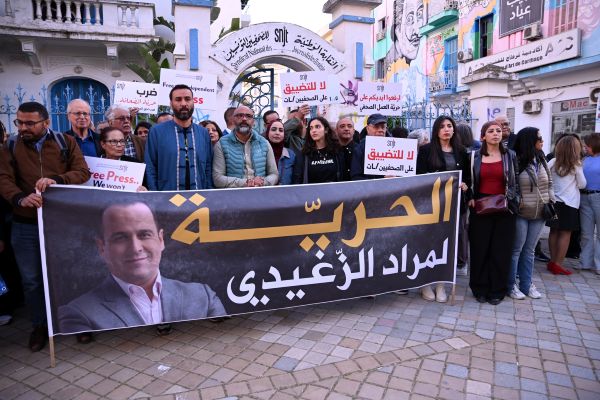
Authorities in Tunisia have announced a one-month suspension of the Tunisian League for Human Rights, one of the oldest human rights organisations in Africa and the Arab world. This organisation is also a member of the National Dialogue Quartet, which was awarded the Nobel Peace Prize in 2015. This suspension raises serious concerns about the ongoing crackdown on civil society in the country.
In a statement released late Friday, the league confirmed the suspension, characterising the decision as “a serious and arbitrary violation of freedom of association” and a “direct assault” on one of Tunisia’s significant democratic gains.
President Kais Saied has frequently cited foreign funding, which many rights organisations rely upon, as a potential threat to Tunisia. He has utilised this perspective to accuse political opponents and social justice activists of being foreign agents inciting unrest.
The league emphasised that this measure should not be viewed in isolation but rather as part of a broader context characterised by systematic pressure on civil society and independent voices within the country. The organisation indicated its intention to challenge what it perceives as an unjust decision in court while continuing to advocate for victims of rights violations without discrimination.
This action follows a series of similar measures targeting rights organisations in Tunisia, where courts mandated multiple prominent NGOs to suspend their activities for a month last year, including those focused on the rights of migrants and women.
The timing of this suspension is notable, as journalist Zied El-Heni has recently been placed under 48-hour detention due to a Facebook post, reflecting a wider pattern of arrests and legal pressure directed at critics of the government. Mohamed Yassine Jlassi, a former president of the Tunisian journalists’ union (SNJT), told The Associated Press during a protest in Tunis that numerous individuals are currently being detained on charges related to free expression, including for social media posts.
“Repression is affecting a broad spectrum of society. Journalism has become criminalised, civil society engagement is increasingly under scrutiny, and political opposition faces considerable challenges,” he stated. “Individuals often find themselves in situations of arbitrary prosecution without the essential guarantees of a fair trial.”
Furthermore, the investigative outlet Inkyfada is facing a court hearing on 11 May, as authorities seek to dissolve Al Khatt, the association that publishes it. The organisation has asserted its disagreement with the legal basis of this case, contending that the government’s claims have not been evaluated by Tunisian courts since 2024.
These developments contribute to growing concerns among rights advocates regarding restrictions imposed on independent media, civil society, and dissenting voices under President Saied, who has consolidated power since 2021 and increasingly targets organisations he claims are receiving foreign funding to provoke unrest and undermine Tunisia’s national interests.
This article used information from The Associated Press.
