
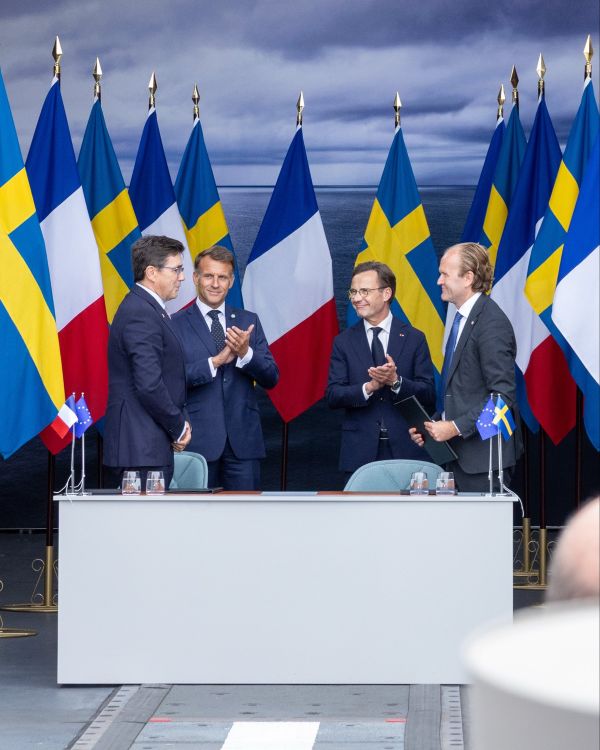
On Monday, France and Sweden agreed to enhance Sweden’s naval capabilities by procuring four modern frigates. This agreement aims to strengthen the defences of NATO’s newest member in the strategically significant Baltic Sea region, where Russia controls critical shipping lanes and airspace.
The signing ceremony took place during President Emmanuel Macron‘s official visit to Sweden, reflecting his commitment to advancing European military autonomy and reducing reliance on the United States.
In the previous week, US officials urged European NATO allies to demonstrate their commitment to bolstering defence amid shifting security priorities that focus more on challenges nearer to home and in the Indo-Pacific region.
Prime Minister Ulf Kristersson of Sweden remarked, “These frigates will serve as platforms that provide long-range capabilities at sea and protection against ballistic missiles,” emphasising the lessons learned from the ongoing conflict in Ukraine regarding the importance of missile defence.
“The developed cooperation with France strengthens Sweden’s security. I welcome closer cooperation, including in the Baltic Sea region and the Arctic, in NATO’s Forward Land Forces Finland, support for Ukraine, countering Russian hybrid threats,” the Swedish prime minister added.
The contract, valued at €4.3 billion, includes provisions for France to supply not only the frigates but also an array of weapons and equipment suited to the vessels. These frigates are designed to carry air-defence interceptors capable of neutralising ballistic missiles, as well as torpedoes and long-range cruise missiles. French officials have confirmed that France will also offer training as part of the agreement. The first vessel is expected to be delivered by the French shipbuilder Naval Group in 2030.
President Macron highlighted this partnership as a “major strategic cooperation” between France and Sweden, asserting that it will reinforce the European defence industrial and technological base. The agreements were formalised aboard the Amiral Ronarc’h, the inaugural ship in a new series of “defence and intervention” frigates, which was launched in 2022 and delivered to the French navy in October 2025. Sweden plans to acquire frigates of the same class.
Discussions between President Macron and Prime Minister Kristersson took place aboard the vessel, followed by a working dinner scheduled for later that evening. French officials indicated that these talks would also explore Sweden’s potential participation in France’s initiative to coordinate nuclear deterrence efforts with European allies. Several countries, including Britain, Germany, the Netherlands, Belgium, Greece, Poland, Denmark, and Norway, have expressed interest in this initiative. This framework would allow France to temporarily deploy nuclear-armed aircraft to allied countries and enable those partners to engage in French deterrence exercises, with non-nuclear allied forces also permitted to participate in supporting activities.
Additionally, France is seeking to acquire defence equipment from Sweden, having placed an order in December for two GlobalEye surveillance aircraft from the Swedish manufacturer Saab.
Sweden officially joined NATO in 2024, becoming the alliance’s 32nd member and marking a significant shift from decades of post-World War II neutrality and centuries of broader nonalignment with major powers. The security landscape in Europe has become increasingly complex since Russia’s full-scale invasion of Ukraine in 2022.
This article used information from The Associated Press.
