
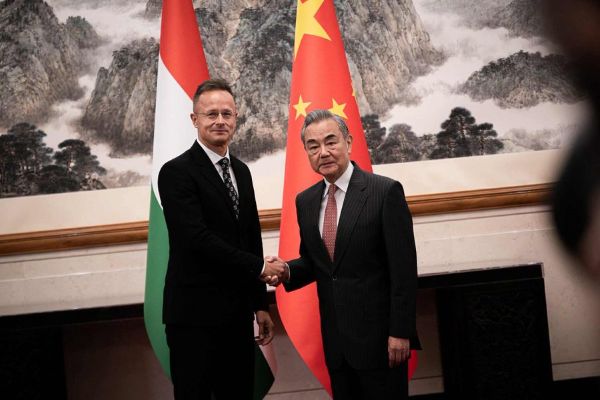
Hungary’s former Foreign Minister, Péter Szijjártó, appeared before a parliamentary committee on Monday to answer questions about his dealings with the Chinese automaker BYD while in office.
Szijjártó left politics in July to assume an executive role at the company. He served as Hungary’s foreign minister for 12 years under former Prime Minister Viktor Orbán until an election defeat in April. In July, he announced his resignation from the Hungarian parliament to take the job at the world’s leading electric car manufacturer.
His announcement sparked accusations of a conflict of interest and criticism of his significant role in facilitating substantial government subsidies for BYD during his time in office. He was instrumental in securing the agreement that allowed BYD to establish its first European factory near Szeged, a city in southern Hungary. Furthermore, in 2025, Szijjártó said BYD would also set up its European headquarters and a research and development centre in Budapest, and would receive 20 billion forints (approximately €56.90 million) in government assistance.
At the closed-door National Security Committee hearing on Monday, Szijjártó told reporters of “serious misunderstandings” about BYD’s investment in Hungary. He did not mention his new position at BYD, which he previously described as an “executive responsible for the group’s external relations and the development of new business lines.”
He stated, “I consider it a great success that this factory came to Hungary,” and added that the proposed and granted government subsidies for the construction of the BYD factory in Szeged were well within the framework of typical subsidies for investments of this size.
Hungary’s new Prime Minister, Péter Magyar, informed lawmakers in July that Szijjártó had assisted BYD with “hundreds of billions of forints” in public funds, diplomatic support, and state infrastructure. An investigation has begun to examine all decisions, negotiations, and state commitments Szijjártó made related to the BYD investment.
During his time in office under Orbán, Szijjártó concluded numerous foreign investment agreements with Chinese companies to establish factories in Hungary, primarily focused on battery production for the electric vehicle sector. Orbán’s government aimed to position Hungary as a global hub for lithium-ion battery manufacturing; however, declining demand and other market pressures have so far prevented these investments from delivering strong returns.
Since taking office in May, Magyar’s government has vowed to implement increased regulation and tighter oversight of the battery production sector following several workplace accidents and findings at multiple plants indicating contamination levels above legal limits.
This article used information from The Associated Press.
