
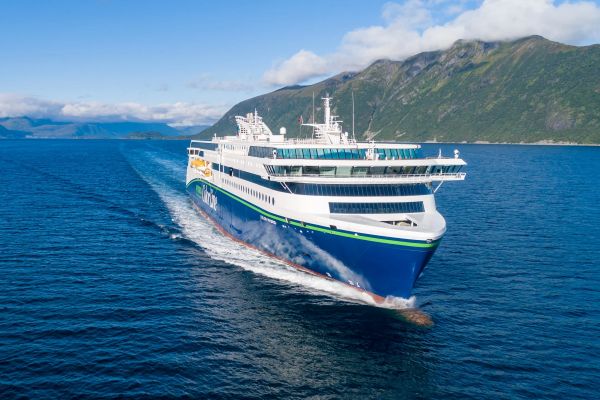
The global maritime industry has reached a major decarbonisation milestone, with the battery-powered commercial vessel fleet surpassing 2,000 ships, according to the Maritime Battery Forum (MBF) Ship Registry. This represents a collective 2.4 GWh of installed maritime battery capacity.
“The technology is ready to scale,” said MBF Managing Director Syb ten Cate Hoedemaker. “Thanks to advancements in battery pricing and technology, we’re passing a crucial tipping point where it makes clear economic sense to build larger, fully electric ships.”
The data reveals diverse vessel types in the battery-powered fleet: 68% operate as hybrids, 13% as plug-in hybrids, and 18% as purely electric vessels. Passenger vessels lead with 570 ships, and the registry also includes 313 offshore vessels, 265 cargo vessels, 219 fishing vessels, and 149 workboats, showing battery technology’s adaptability across maritime applications.
Europe, led by Norway, operates most of the documented battery-powered fleet. However, the global total is substantially larger, as the register currently tracks only 267 ships in China despite the country’s actual fleet being significantly greater.
Despite these technological achievements, industry leaders emphasise that market momentum alone cannot fully decarbonise global shipping. The sector urgently needs the Net-Zero Framework (NZF), a policy up for adoption at the UN’s International Maritime Organisation this December.
“Regulatory pressure and ambitious global frameworks are essential to scaling up these technologies even further,” notes Madadh MacLaine, Secretary-General of the Zero Emissions Ship Technology Association (ZESTA). “Only a strong global fuel standard and pricing mechanism can drive the global uptake of zero-emission fuels and technologies, including batteries.”
