
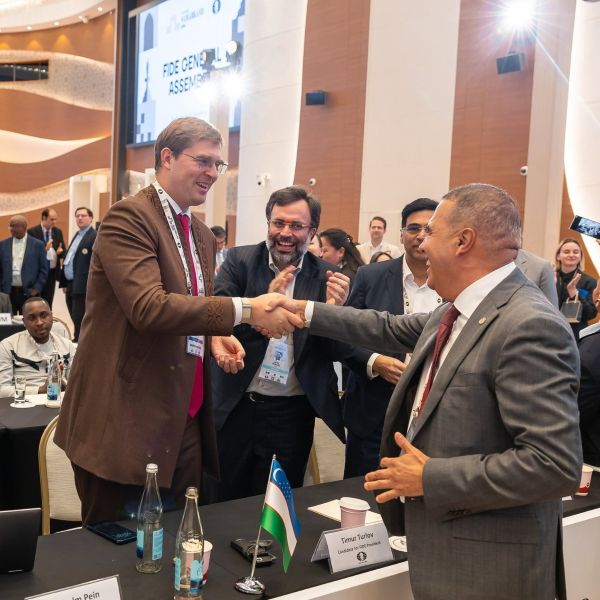
Timur Turlov has become the new president of the International Chess Federation, placing a 38-year-old Kazakh entrepreneur at the head of world chess after the FIDE election 2026. The vote in Samarkand on 26 September ended with Turlov defeating German businessman Wadim Rosenstein in a second round, according to the official FIDE election announcement.
The result brings together two parts of Turlov’s career that had developed in parallel: financial services and chess administration. He remains founder and chief executive of Freedom Holding Corp., while his running mate, five-time world champion Viswanathan Anand, was elected FIDE Deputy President.
Timur Turlov elected FIDE President: Results
Timur Turlov was elected FIDE president after a runoff at the General Assembly held during the 46th Chess Olympiad in Samarkand, Uzbekistan. According to FIDE’s official result published on 26 September, 2026, delegates representing 196 national chess federations took part in the election.
In the first round, Turlov received 96 votes, Rosenstein 76 and Jan Henric Buettner 20, with 192 votes cast; 4 participants abstained from voting. Turlov therefore fell just short of the majority needed for an immediate victory, and the two leading candidates advanced to the second ballot.
The runoff produced a clearer result: Turlov won 110 votes to Rosenstein’s 85. FIDE described him as its eighth president and the second-youngest person ever elected to the office. Anand, who had served as FIDE Deputy President since 2022, was elected on the same ticket.
The vote also ended Arkady Dvorkovich‘s presidency after two terms from 2018 to 2026. For FIDE, the change is significant because the incoming president is not a former government official or elite grandmaster but an entrepreneur whose management record was the central argument of his campaign.
Who is Timur Turlov
Timur Turlov is a Kazakhstan-based financier born on 13 November, 1987, who built his career around access to international securities markets. His official biography says he started working as a trader at a Moscow office of World Capital Investments (WCI) at the age of 16, later helped develop infrastructure for access to the US stock market at a unit of Uniastrum Bank, and earned a degree in economics and management.
He founded Freedom Finance in 2008, when he was 21, and expanded the brokerage into Kazakhstan in 2012. The businesses were later consolidated under Freedom Holding Corp., whose shares began trading on Nasdaq in October 2019 under the ticker FRHC.
Turlov lives in Almaty and represents Kazakhstan in international chess administration. During the election, his citizenship history became one of the issues raised by rivals. In its 5 September, 2026 Electoral Commission report, FIDE said documents submitted by Turlov appeared to demonstrate that he was no longer a Russian citizen and confirmed that his Kazakh citizenship was undisputed. Freedom Holding’s SEC filings also state that the group divested its Russian subsidiaries in February 2023.
The phrase “Turlov net worth” frequently appears in profiles because most of his wealth is linked to his stake in Freedom Holding. Forbes estimated his real-time net worth at $7.4 billion as of 7 October, 2026; its annual 2026 billionaires snapshot had valued his fortune at $5.2 billion as of 10 March.
Turlov’s business: Freedom Holding and Freedom Bank
Freedom Holding is the main source of Turlov’s business profile and financial influence. According to a Schedule 13D/A filing submitted to SEC in September 2026, he beneficially owned approximately 64.91% of the company’s shares, making him its controlling shareholder. The group has grown well beyond its original brokerage business. Its 2026 annual report filed with the SEC divides operations into brokerage, banking, insurance and other activities, with subsidiaries or a presence across Central Asia, Europe, the United States and other markets. As of 31 March 2026, the company reported 11,846 employees and 230 offices.
For the fiscal year ended 31 March 2026, Freedom Holding reported net revenue of $2.19 billion, net income of $153.3 million and total assets of $13.16 billion. By 30 June 2026, total assets had increased to $14.05 billion, while first-quarter revenue for fiscal 2027 reached $732.5 million, according to the company’s results published on 10 August, 2026.
Freedom Bank Kazakhstan is a central part of that ecosystem. For the quarter ended 30 June 2026, Freedom Holding reported banking-segment revenue of $225.2 million and said the segment served about 5.45 million customers. The broader group also operates brokerage, insurance, payments, telecommunications, travel and other consumer services.
The company’s scale gives Turlov resources and management experience unusual for the head of an international sports federation, but it also creates governance questions.
How Turlov came to chess
Turlov’s connection to chess predates his move into sports administration, but his institutional role is relatively recent. His official biography describes chess as one of his personal interests and says he plays with his children, while his public involvement in the sport moved to a different level when he became president of the Kazakhstan Chess Federation in January 2023.
Since then, his public chess activity has focused less on elite play than on financing, school programs, tournament infrastructure and the use of technology to broaden participation. Those priorities later became central elements of his campaign for the FIDE presidency.
Freedom Holding has also become a significant chess sponsor. The company’s SEC-filed annual report says it recorded about $10.0 million in advertising and sponsorship expense connected with the Kazakhstan Chess Federation during the fiscal year ended 31 March 2026, supporting championships, tournaments, training camps and other events.
Turlov also led the International School Chess Federation before winning the FIDE presidency. His campaign presented school chess as one of the areas where a federation can produce measurable long-term growth by connecting national organisations, educators, schools and young players rather than concentrating only on top-level tournaments.
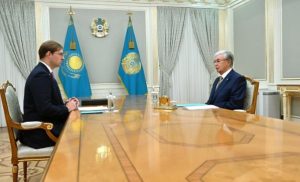
[President of the Republic of Kazakhstan Kassym-Jomart Tokayev congratulated newly elected FIDE President Timur Turlov on his election to lead the International Chess Federation. Credit: International Chess Federation@FIDE_chess]
Turlov’s programme for FIDE
Turlov’s programme for FIDE centred on several priorities: digital transformation, chess in education, financial sustainability and institutional development. His official campaign platform presented these as management problems that could be addressed with common infrastructure, longer-term funding and more measurable support for national federations.
The most visible proposal was a unified digital platform for FIDE. The campaign said players should be able to use one account for ratings, tournament records, online competition and educational services, while federations should gain equal access to modern administrative tools. Turlov also promoted more use of technology and artificial intelligence in analysis, training and fair-play systems.
Education was the second major pillar. His programme proposed expanding chess inside national education systems and using experience from Kazakhstan and the International School Chess Federation as models that could be adapted to local conditions rather than imposed as one global template.
On finance, Turlov argued that national federations need more predictable sources of income instead of relying only on occasional grants or individual sponsors. The programme called for stronger commercial partnerships, better long-term planning and direct support for federations with limited resources.
The platform also covered professional chess. It promised a competition calendar published further in advance, better conditions and development opportunities for players, coaches, arbiters and organisers, larger prize funds and dedicated initiatives for women’s chess, as well as continued social programs designed to bring chess to a wider public.
The election campaign
The FIDE election 2026 was a three-way contest between business-led tickets with very different networks in the chess world. According to FIDE’s final election report, the ballot featured Turlov and Anand, Rosenstein and Gordon Tang, and Buettner and Malcolm Pein.
Turlov’s campaign used the slogan “Moving Chess Forward. Together” and argued for continuity combined with faster execution. Anand’s presence on the ticket gave the bid a globally recognised chess figure with four years of experience as FIDE Deputy President. The campaign’s detailed proposals were published on the Turlov for Chess website.
What Turlov’s presidency means for World Chess
Turlov’s presidency is likely to be judged first on whether the proposals set out in his FIDE campaign programme become institutional projects rather than remain election promises. The clearest tests will be progress on digital infrastructure, school-chess expansion, financial support for smaller federations and the ability to plan major competitions further ahead.
His election also highlights the growing role of Central Asia in international chess. Kazakhstan has invested heavily in youth programs and hosted major events, while Turlov’s own rise from national federation president to FIDE president gives the region a direct role in setting the sport’s global agenda.
For players and national federations, the central question is whether the new administration improves services and opportunities. If the Turlov chess agenda delivers more reliable funding, better digital tools and broader school participation while preserving transparent governance, it could change how FIDE operates.
Turlov proposed nearly quadrupling FIDE’s budget, from $1.8 million to $7 million. He pledged to cover the first year with his own funds. In subsequent years, he plans to seek support from philanthropists and corporate sponsors, while strengthening the marketing capabilities of both FIDE and national chess federations.
