
The ultranationalist Law and Justice (PiS) party ruled Poland for eight years, until it lost its parliamentary majority in 2023. During its governance, PiS sought to establish an authoritarian regime by promoting anti-immigration policies and fostering nationalist sentiment against the EU and its values. This approach led to a rise in racist attitudes towards foreigners and increased violence against them.
The Russian invasion of Ukraine exacerbated xenophobic behaviour, particularly towards Ukrainian refugees entering Poland. Additionally, the election of nationalist-populist Karol Nawrocki as President in 2025 further fuelled the growth of far-right parties and xenophobia, with Ukrainians, including children and young people, becoming new targets.
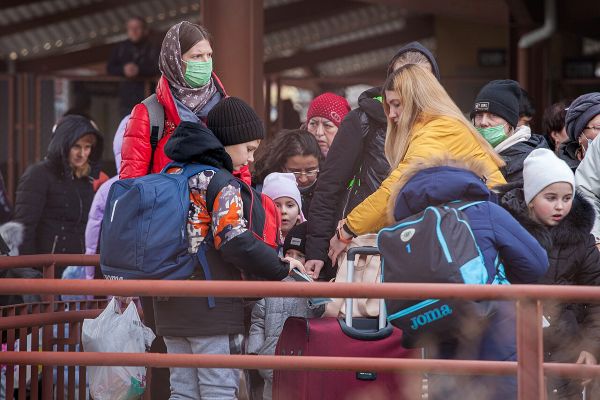
Legnica, Gdańsk, Olsztyn, Szczecin, Warsaw, and Wrocław are among the Polish cities where refugee children have recently faced assaults. The ‘NEVER AGAIN’ Association has published a report titled “This Is a Polish Bench,” highlighting xenophobic hostility towards children and young people, which has been shared with the Office of the Ombudsman for Children, the Office of the Commissioner for Human Rights, and the Ministry of National Education.
The 50-page report documents instances of discrimination against refugee children, particularly those from Ukraine, as well as children from migrant families, those with darker skin tones, and children with disabilities.
It covers incidents from 2022 to 2026, including school harassment and threats directed at children both in person and on social media. Such incidents increased notably in 2026 compared to previous years.- “Violence against children is morally reprehensible, yet for far-right propagandists who spread this hatred, only their political and financial interests matter,” comments Łukasz Jakubowski, a representative of the ‘NEVER AGAIN’ Association.
Poland’s non-university education system hosts students from 148 countries, representing 5.3% of the overall student population. This diverse cohort includes 353,000 individuals: 237,000 school pupils, 62,600 nursery school children, and 53,400 adult learners. Most of these international students are from Ukraine (84%), followed by Belarus (9%) and Russia (1%). Additionally, Vietnam and India each account for less than 1% of this demographic. In the Polish school system, children from Ukraine represent 4.1% of all pupils.
Children, pregnant women and disabled pupils
The report outlines several incidents of xenophobic aggression and violence:
On 2 September 2022, in Warsaw, the capital of Poland, a group of men and a woman shouted xenophobic insults at Ukrainian youths playing football, saying, “This is a Polish school! Not Ukrainian!”
On 7 January 2023, in Lublin, two men assaulted a Ukrainian woman, her 13-year-old son, and her pregnant daughter, hurling insults and physically attacking them when the boy tried to call the police.
Then, on 31 August 2023, teenagers brutally beat two Afghan refugee brothers at a local football pitch in Bielsko-Biała.
On 7 June 2024, Grzegorz Płaczek, an MP for the far-right Confederation and chairman of its parliamentary club, spread false claims on TikTok about preferential treatment for Ukrainian children in healthcare. President Nawrocki rewarded him by appointing him to the Council of Parliamentarians to the President of the Republic of Poland last January.
On 1 August 2025, in Szczecin, a Facebook user incited violence against individuals with disabilities, including a girl with Down syndrome.
On 25 September 2025, in Ostrów Mazowiecka, a resident assaulted an 11-year-old dark-skinned boy with racist abuse.
On 17 November 2025, several students attacked four Ukrainian teens at a bus stop in Słupsk, shouting xenophobic slurs and causing injuries.
In Poznań, on 15 July 2026, Prof. Stanislaw Zerko mocked refugee children on Twitter/X using a photo of Alan Kurdi, a three-year-old Syrian refugee who drowned in 2015. Zerko mockingly captioned the image, “I was so moved, my eyes filled with mustard.”
In Legnica, on 18 July 2026, Karolina O. attacked six Ukrainian girls in a playground, physically assaulting one of them.
On 3 August 2026, a man verbally assaulted a Ukrainian teenager at a tram stop in Łódź, expressing hostility towards their nationality.
On 14 August 2026, a woman and a man attacked two Ukrainian siblings for speaking their language in Bydgoszcz.
Fighting discrimination and xenophobia in Poland
The ‘NEVER AGAIN’ Association provides anti-discrimination training for teachers, youth workers, and students, focusing on recognising racism and supporting victims of prejudice. Since 2020, it has run the Watch Out initiative with the Forward Foundation, offering online educational resources. Founded in Warsaw in 1996, the Association publishes reports on discrimination, especially against Ukrainians during the war. Through its Minorities for Peace initiative, it supports Ukrainian refugees and anti-war dissidents in collaboration with the European Network for Solidarity with Ukraine (ENSU).
