
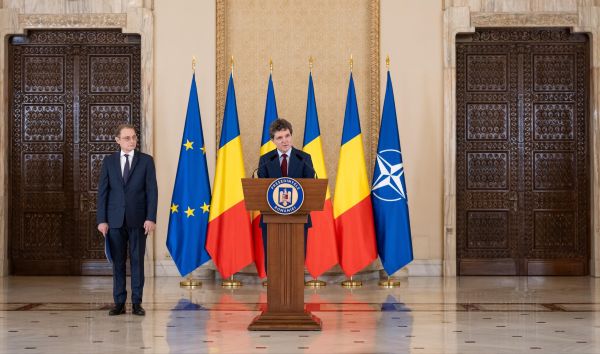
Romania’s Social Democratic Party (PSD) have announced its intention to join the government of Prime Minister-designate Luca Niculescu, with support commitments from several other parties. This development marks a significant step toward resolving a political crisis that has adversely affected the country’s investment-grade rating.
The PSD, the predominant party in parliament, is slated to hold 11 ministerial positions in the proposed government. Technocrats will take additional ministerial roles, responsible for key areas such as finance, energy, and foreign affairs.
Although other pro-European parties have chosen not to participate in the cabinet, some have said they intend to support Niculescu, thereby securing the 233 votes needed for the vote of confidence.
Luca Niculescu, 55, a diplomat and former journalist, currently serves as the interim deputy foreign minister. He will lead centrist President Nicușor Dan‘s fourth attempt to form a government after a pro-European coalition cabinet dissolved five months ago.
The previous four-party government, led by National Liberal Party (PNL) head Ilie Bolojan, disbanded in early May when the PSD withdrew its support and aligned with the extremist far-right Alliance for the Union of Romanians (AUR) to submit a no-confidence motion.
The PSD has said it wants to form a similar coalition under a different prime minister; however, the PNL and two other centre-right parties have declined to engage in such discussions.
Ongoing political instability has driven the Romanian leu to unprecedented lows and pushed debt yields higher. Romania narrowly averted a downgrade of its investment-grade rating. Rating agencies have said the country’s success in approving a 2027 budget, aimed at significantly reducing one of the EU’s largest deficits, will be critical to maintaining its current rating.
While Niculescu’s government is expected to gain parliamentary approval, its success remains uncertain. The PSD has outlined conditions for its support, including presenting a 2027 budget plan by 1st December and ensuring no further tax increases. Additionally, the PSD will assess the cabinet’s performance in six months.
Romania has committed to working with Brussels to reduce its budget deficit to below 3% of economic output by 2030, down from over 9% in 2024 and expected to be 6.2% this year.
